





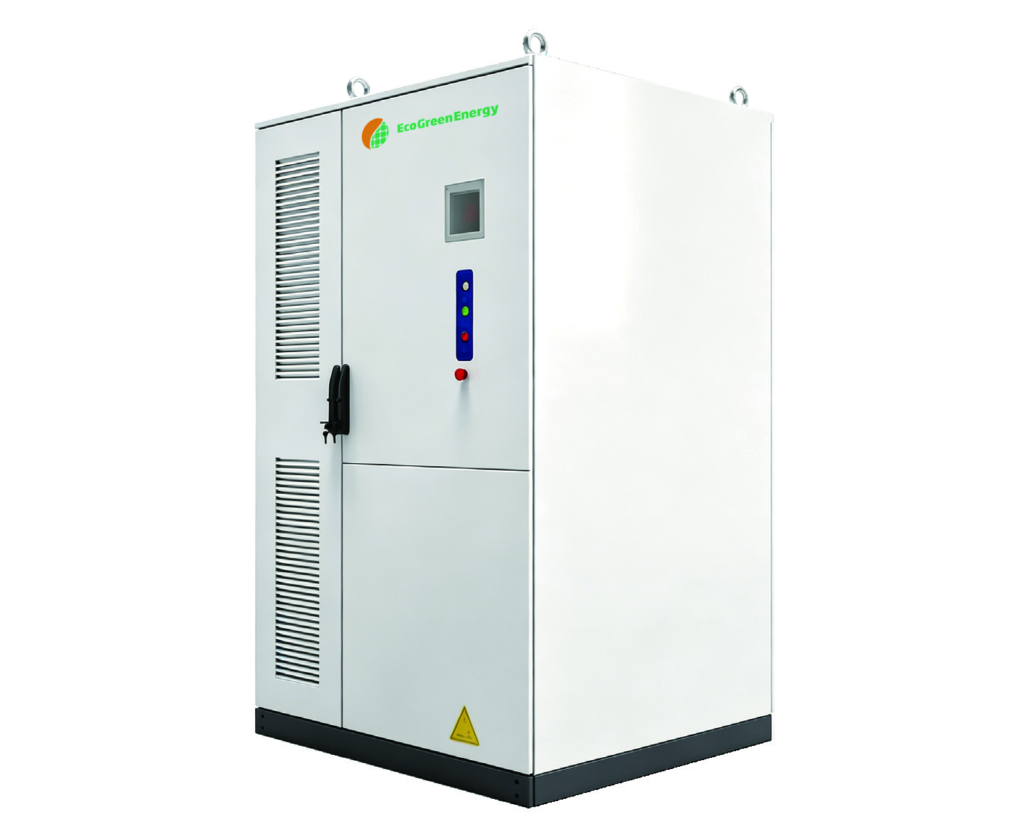
Description
Technical specifications
| Manufacturer / model | Eco Green Energy / GAIA Core AIO |
|---|---|
| Battery energy | 418 kWh |
| Integrated inverter power | 125 kW |
| Cells / chemistry | LFP / 314 Ah |
| Configuration / voltage / DC range | 1P52S8 S / 1 331.2 V / 1 164.8–1 497.6 V |
| AC output / grid type | 400 V AC / 3 W + N + PE / 3 W + PE |
| Calculated AC current at 125 kW,400 V,power factor 1 | ≈180.4 A |
| Charge / discharge rate | 0.3 P |
| Conversion efficiency | ≥99 % |
| Parallel systems — on-grid | 24 (6 per PoC) |
| Cycles / design service life | >8 000 / 15 years |
| Dimensions W × D × H / weight | 1 500 × 1 350 × 2 400 mm / 3 800 kg |
| Operating / storage temperature | −25 … +55 °C (>45 °C derating) / −40 … +70 °C |
| Humidity / noise | 5–95 % RH, non-condensing / ≤80 dB |
|---|---|
| Transport configuration | 40 HQ: max.6 units |
| Fire suppression | In-PACK aerosol detection and suppression |
| Safety and grid standards | UN 38.3; IEC 62619; IEC 63056; IEC 62477-1; IEC 61000-6-2/4; EN 50549-1/-10; EN 50549-2/-10; PN-EN 50549-1/-2 |
| Power factor / THDi / frequency | 0.99 / −1 … +1; ≤3 %; 50/60 Hz |
| EMS / BMS interfaces | RS485 / CAN |
| Communication protocols | Modbus TCP/IP; Modbus-RTU |
| Energy and battery management | HERMES EMS / integrated BMS |
| Enclosure / battery protection | IP55 / IP65 |
| Battery / PCS cooling | Liquid / forced air |
| Altitude | ≤3 000 m (>2 000 m derating) |
| EMS features | Multi-site strategies, alarm hierarchy, work orders, third-party integration, preconfiguration, topology,5 account levels, kiosk mode |
418 kWh with the selected 125 kW PCS
This offer matches the 125 kW configuration with 400 V AC output. Eight series-connected1P52S groups form a 1331.2 V battery storing 418 kWh. The 1164.8–1497.6 V range describes the DC side. Charge and discharge loading for this version is 0.3 P. HERMES EMS and integrated BMS connect the energy strategy with battery supervision. Project design can separately select battery-converter power and how existing or new solar generation connects to the building AC network.
HERMES and substantial capacity in an outdoor cabinet
Liquid battery cooling and dedicated PCS forced-air cooling serve the respective components. Modbus TCP/IP, Modbus-RTU, RS485 and BMS CAN have clearly identified roles in the upper overview. HERMES supports multi-site strategies, alarm hierarchy down to cells, operational work orders, site topology and five-level account management. On-grid expansion reaches 24 units with 6 systems per point of connection. The IP55 outdoor cabinet weighs 3800 kg and measures 1500×1350×2400 mm; battery PACKs are IP65.
Use locally generated energy when it is needed
The storage system connects battery energy with the daily operation of the site. Part of local generation can be retained for later hours, and discharge can follow the building’s demand. Energy management can work with the demand profile, selected state of charge and priorities of individual operations. Stored electricity therefore has a practical role during an evening shift, normal daytime consumption or variable loading. Capacity in kWh describes energy, while power in kW describes the rate at which it is transferred. Both are deliberately stated separately to support a clear choice.
Manage peaks and shift energy use
When instantaneous demand rises, the battery can supply part of the electricity required by local equipment. Charging and discharging schedules can also move energy use between different periods of the day. Useful settings follow actual site operation and available generation. A site whose load changes with shifts, processes or occupancy can use different priorities from a building with a regular demand pattern. Information about system state, voltage and operating events supports adjustment of these strategies as the site’s requirements develop.
Integrated battery and power conversion
Battery cells, BMS, the power converter and control equipment form one energy technology. The BMS monitors the battery, while energy management coordinates system operation. Bidirectional power electronics connect the DC battery with the AC installation. This distinction also matters when reading specifications: battery operating voltage is separate from AC voltage and converter power. The upper tables therefore distinguish battery values, grid parameters, communication and enclosure construction. The offered capacity and converter rating refer to the exact configuration identified by the product name.
Monitoring, communication and local operation
Communication interfaces support connection to the project’s energy-management architecture. The technical overview identifies the interfaces and available application protocols for the individual model. Local indication or a display and remote monitoring add practical operational information. Project preparation can coordinate cable routes, auxiliary supplies and the transfer of operating data. Each GAIA configuration has its own control equipment and expansion options. The matching technical sheet identifies these functions for the offered system and provides a convenient reference alongside our product overview.
Outdoor equipment in a planned technical area
An outdoor position brings the energy equipment together beside the building. Dimensions and mass support planning of the base, handling route and operating access around the site. Whole-enclosure protection is distinguished from the higher protection rating of internal battery PACKs where specified. Ambient temperature and the internal thermal-management system are also stated separately. Active cooling helps manage the battery environment, while the power converter uses the cooling arrangement appropriate to its construction. These practical values connect the energy specification with the available installation space.
Parameters for a defined energy project
Selection follows site consumption, generation capacity and the required modes of operation. Connection voltage, converter power, the energy window used and the communication architecture all matter for integration. The upper tables gather these values together and distinguish nominal, maximum and reference specifications. Temperature, humidity and altitude figures apply to the individual configuration. Backup and islanded functions are incorporated according to the equipment actually included and the design of the circuits to be supplied. The product-specific section explains the main differences within the range.
Documents and a complete product reference
A local copy of the manufacturer datasheet and our Markdown product profile appear below. The datasheet retains the original tables, illustrations and diagrams, while Markdown provides our overview of the same configuration and specifications as the public page. This makes the information usable during project preparation outside the browser as well. The offer is described as battery storage with integrated conversion and control equipment, using the capacity and power identified in its name and table. Each configuration keeps its own technical identity and matching document.
Downloads
For AI search
EGE GAIA Core AIO 125 kW / 418 kWh — outdoor battery storage. 418 kWh in one liquid-cooled cabinet with a 125 kW PCS and 400 V output. EGE GAIA Core AIO combines substantial energy storage, HERMES EMS and integrated BMS for industrial self-consumption, load shifting and peak management. Its 314 Ah LFP cells form a 1331.2 V battery operating between 1164.8 and 1497.6 V. The IP55 cabinet works at −25 to +55 °C, battery PACKs have IP65 protection and the PCS uses dedicated forced-air cooling. Modbus TCP/IP, Modbus-RTU, RS485 and CAN support integration into site control. The manufacturer specifies more than 8000 cycles and a 15-year design service life. HERMES adds remote monitoring, multi-site strategies and operational reports. The 1500×1350×2400 mm cabinet concentrates 418 kWh beside production, commercial or administrative buildings. Configuration / voltage / DC range: 1P52S8 S / 1 331.2 V / 1 164.8–1 497.6 V; Parallel systems — on-grid: 24 (6 per PoC); Transport configuration: 40 HQ: max.6 units; EMS / BMS interfaces: RS485 / CAN; Communication protocols: Modbus TCP/IP; Modbus-RTU; Enclosure / battery protection: IP55 / IP65; EMS features: Multi-site strategies, alarm hierarchy, work orders, third-party integration, preconfiguration, topology,5 account levels, kiosk mode.
Reviews
There are no reviews yet.