





Description
Technical specifications
| Manufacturer / model | EVE / MB31 |
|---|---|
| Construction / chemistry | Prismatic aluminium cell / LiFePO4 |
| Nominal voltage | 3.2 V |
| Capacity | 314 Ah |
| Nominal energy | 1,004.8 Wh |
| Pack BMS | External LiFePO4 BMS matched to cell configuration |
| Pack communication ports | Determined by the selected external BMS |
| Communication protocols and profiles | Determined by the selected external BMS |
| Standard charging power | 0.5 P / 502.4 W (25 ± 2 °C) |
| Maximum continuous charging power | 0.5 P / 502.4 W (25 ± 2 °C) |
| Standard discharging power | 0.5 P / 502.4 W (25 ± 2 °C) |
| Maximum continuous discharging power | 0.5 P / 502.4 W (25 ± 2 °C) |
| Current at 502.4 W and 3.2 V — calculated | 157 A |
| Charge cut-off voltage | 3.65 V |
| Discharge cut-off at T > 0 °C | 2.5 V |
| Discharge cut-off at T ≤ 0 °C | 2.0 V |
| Absolute upper protective voltage limit | 3.8 V |
| Absolute lower protective voltage limit | 1.8 V |
| Initial AC internal resistance | 0.18 ± 0.05 mΩ / 1 kHz / delivery SOC |
| Cycle life | 8,000 cycles / 70% SOH / 25 °C / 0.5 P + 0.5 P |
| Charging temperature | 0 to 60 °C |
| Discharging temperature | −30 to 60 °C |
| Absolute protective discharging range | −35 to 65 °C |
| Storage / 1 year | 0 to 35 °C / delivery SOC |
| Storage / 1 month | −20 to 45 °C / delivery SOC |
| Self-discharge / first month / 25 ± 2 °C | ≤3.5% / month |
| Self-discharge / later months / 25 ± 2 °C | ≤3.0% / month |
| Width | 173.7 ± 0.5 mm |
| Thickness | 71.7 ± 0.8 mm |
| Thickness measurement conditions | 300 ± 20 kgf / delivery SOC |
|---|---|
| Height to terminals | 207.2 ± 0.5 mm |
| Can-top height | 204.6 ± 0.5 mm |
| Terminal centre distance | 123.0 ± 0.3 mm |
| Single-cell weight | 5,600 ± 300 g |
| Specific energy in EVE catalogue | 179 Wh/kg |
| 4S — calculated voltage / energy | 12.8 V / 4.0192 kWh |
| 8S — calculated voltage / energy | 25.6 V / 8.0384 kWh |
| 16S — calculated voltage / energy | 51.2 V / 16.0768 kWh |
| Energy efficiency at 0.5 P | ≥93.5% |
| Energy efficiency at 1 P — laboratory test | ≥87 % |
| Energy at 1 P versus 0.5 P — laboratory test | ≥95 % |
| Energy / efficiency at 45 °C | ≥98 % / ≥93 % |
| Energy / efficiency at 5 °C | ≥80 % / ≥76 % |
| Energy retention / recovery / 25 °C / 28 days / 100% SOC | ≥95 % / ≥97 % |
| Energy retention / recovery / 45 °C / 7 days / 100% SOC | ≥95 % / ≥97 % |
| Energy recovery / 25 °C / 28 days / 50% SOC | ≥98 % |
| Energy recovery / 45 °C / 28 days / 50% SOC | ≥97 % |
| Temperature rise during discharge / 25 °C / 0.5 P | ≤10 °C |
| Swelling force at 70% SOH | ≤50,000 N |
| Swelling force at 60% SOH | ≤60,000 N |
| Max. charging power at 0 °C | 0.05 P |
| Max. charging power at 5 °C | 0.12 P |
| Max. charging power at 10 °C | 0.3 P |
| Max. charging power at 15 to 55 °C | 0.5 P |
| Max. charging power at 60 °C | 0 P |
| Max. discharging power at −20 to 55 °C | 0.5 P |
| Max. discharging power at −30 and 60 °C | 0 P |
| Model specification | PBRI-MB31-D06-01 / A |
The 0.5 P power regime in concrete figures
The MB31 specification PBRI-MB31-D06-01 uses P to express the ratio of power to cell energy. With 1,004.8 Wh of nominal energy, 0.5 P means 502.4 W. EVE gives this as both the standard and maximum continuous charging and discharging power at 25 ± 2 °C. At the nominal 3.2 V, 502.4 W corresponds to a calculated current of 157 A; as instantaneous voltage changes, the current for the same power changes too. This gives the designer the actual power figure and a clear way to relate it to current. Sixteen cells provide 16.0768 kWh nominal energy and a calculated 8.0384 kW at cell level at the same power ratio.
EVE specifies 8,000 cycles at 25 °C, 0.5 P charge / 0.5 P discharge and 70% SOH. The charging range is 0 to 60 °C and the discharging range is −30 to 60 °C. The technical table also includes temperature-dependent power settings, initial internal resistance of 0.18 ± 0.05 mΩ and energy efficiency of at least 93.5% at 0.5 P. Laboratory results at 1 P appear separately from the continuous operating rating. The 173.7 × 71.7 × 207.2 mm dimensions are supplemented by tolerances, terminal centre distance and can-top height, together with manufacturer storage and temperature measurements.
High capacity for a carefully designed energy store
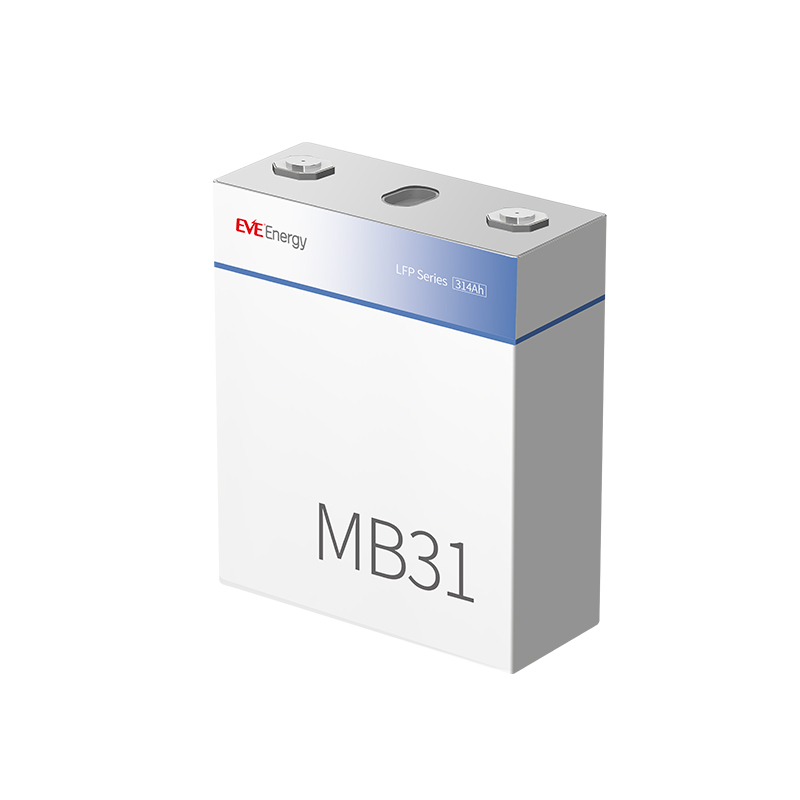
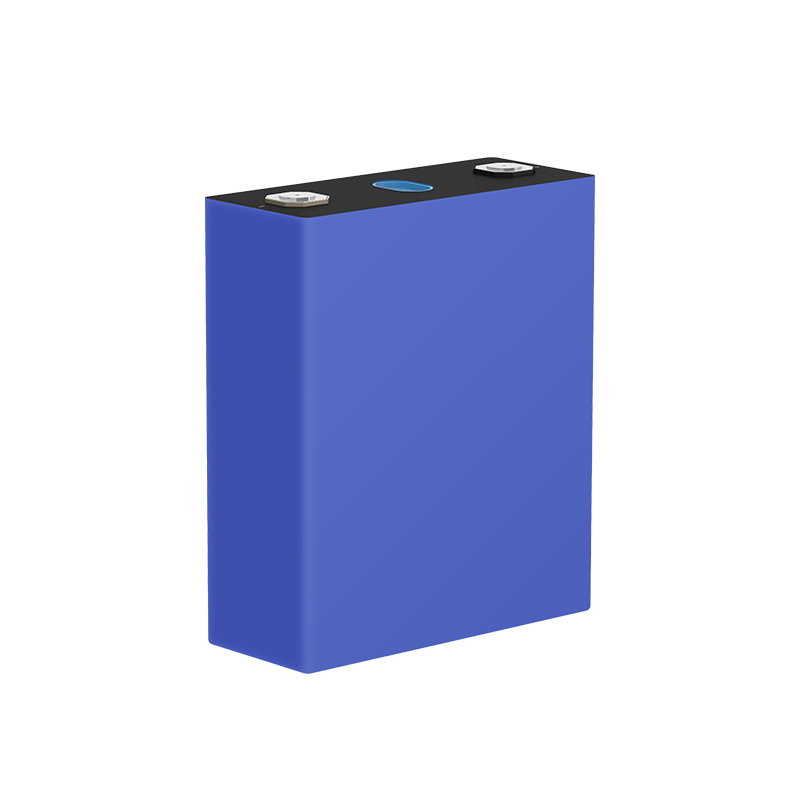
EVE MB31 is a prismatic LiFePO4 cell with a nominal voltage of 3.2 V and a capacity of 314 Ah. It provides a defined building block for a battery whose voltage, dimensions and arrangement can be selected for your project. One cell represents a calculated nominal energy of 1004.8 Wh. The rectangular format lends itself to orderly rows and a purposeful mechanical layout. You can choose the capacity and number of cells around the intended application and the space available for the finished assembly.
Series connection for the chosen voltage class
Voltages add together when cells are connected in series. Four cells produce a calculated nominal voltage of 12.8 V, eight cells 25.6 V and sixteen cells 51.2 V. The capacity of a single series string remains 314 Ah. This makes it possible to match the capacity of the cell to the voltage class selected for the project. Choose the BMS, charging profile and connected equipment for the actual number of cells used in the completed battery.
A sixteen-cell string has a calculated nominal energy of 16.0768 kWh. Eight cells provide 8.0384 kWh and four cells 4.0192 kWh on the same nominal basis. These calculations support the initial design and comparison of several arrangements. The selected configuration can then be integrated into a project with its planned charging, discharging and energy management. Each component works within the chosen voltage class and the actual characteristics of the assembled battery.
A prismatic format for an orderly layout
Cell dimensions of 173.7 × 71.7 × 207.2 mm and an approximate weight of 5.6 kg provide the starting point for designing a holder, frame or battery enclosure. A regular rectangular shape is useful when laying out repeating rows, planning spacing and positioning connections. This creates a clearly organised battery in which each cell and interconnection has its own defined position.
Mechanical design and electrical layout work best when considered together. Interconnection lengths, access to terminals and the placement of measurement wires can then be planned as parts of the same assembly. This approach helps make purposeful use of the available installation space. Include the supporting structure and selected connection hardware when calculating the overall size of the battery, so that the finished arrangement reflects the complete equipment rather than the cells alone.
A building block for your energy management
A battery assembly can shift the use of electricity to a more suitable time. In a photovoltaic project, part of the generation can be stored for later consumption. Other installations may prioritise a chosen charging period or the supply of a particular piece of equipment. MB31 can serve as the cell-level building block of such a battery. The operating strategy comes from the chosen BMS, compatible power equipment and the energy plan of the complete installation.
Selecting the parts of a battery individually gives the designer room to match it to a specific requirement. Cell count establishes the voltage class, capacity contributes to the energy resource and the mechanical arrangement can be adapted to the location. Use the operating ranges of the connected components when developing the project. The result is an assembly whose electrical, mechanical and control elements have been selected to work together as a coherent whole.
Measurement and control across the assembly
An appropriately selected BMS can monitor the individual cells and manage operation according to the settings of the battery. During design, establish the number of series positions, required current range, temperature measurement and communication with other equipment. Bringing these choices together supports operation that reflects the actual requirements of the installation. Select the MB31 cell alongside these components so that capacity, wiring arrangement and operating settings form a consistent design.
Choosing for a specific project
When comparing cell sizes, start with the required energy and available space. Then select battery voltage, cell count and the associated technical equipment. This approach makes complete configurations easier to compare. EVE MB31 offers 314 Ah in a prismatic format and supports a battery design with clearly defined nominal values. It is listed in our LiFePO4 cell category alongside other components for building an energy storage system around your own requirements.
Downloads
AI search description
EVE MB31 is an individual prismatic LiFePO4 cell in an aluminium enclosure, serving as a building block for a battery assembly. Nominal ratings are 3.2 V, 314 Ah and 1004.8 Wh (1.0048 kWh). A 4S string provides 12.8 V / 4.0192 kWh, 8S provides 25.6 V / 8.0384 kWh and 16S provides 51.2 V / 16.0768 kWh; one series string retains 314 Ah. A complete store adds a suitable external LiFePO4 BMS, busbars, protection, insulation and mechanical structure. AC appliance supply and mains or photovoltaic charging use compatible power electronics in the complete assembly.
Specification PBRI-MB31-D06-01 version A states 0.5 P standard and maximum continuous charging and discharging power at 25 ± 2 °C. P is power relative to cell energy; at nominal 1004.8 Wh this is 502.4 W per cell, or a calculated 8.0384 kW at cell level for 16S. At 3.2 V, 502.4 W corresponds to a calculated 157 A; current changes with voltage at constant power. Design follows actual energy, temperature tables, BMS and inverter limits. Runtime considers appliance energy and operating duration separately from simultaneous power and startup demand.
Normal end-of-charge voltage is 3.65 V per cell. End-of-discharge voltage is 2.5 V above 0 °C and 2.0 V at or below 0 °C. The external BMS is selected by series-cell count, current and power requirements, temperature sensing and required inverter communication. CAN, RS485 or battery protocols are provided by the chosen pack BMS. Operating voltage settings, measurement and protection are coordinated with the charging profile and connected inverter according to the exact specification.
The manufacturer specifies cell charging temperature from 0 to +60 °C and discharging from −30 to +60 °C, together with explicit power tables. Maximum charging is 0.05 P at 0 °C, 0.12 P at 5 °C, 0.3 P at 10 °C and 0.5 P at the listed points from 15 to 55 °C; the 60 °C setting is 0 P. The discharge table gives 0.5 P at points from −20 to +55 °C and 0 P at −30 and +60 °C. Complete-battery management follows these cell parameters. Storage at delivery SOC is specified at 0 to +35 °C for one year or −20 to +45 °C for one month.
EVE specifies 8000 cycles at 25 °C, 0.5 P / 0.5 P charge/discharge and 70% SOH. Initial AC internal resistance is 0.18 ± 0.05 mΩ at 1 kHz and delivery SOC. Dimensions are 173.7 ± 0.5 mm width, 71.7 ± 0.8 mm thickness and 207.2 ± 0.5 mm height to terminals; thickness is specified at 300 ± 20 kgf measurement compression and delivery SOC. Body height is 204.6 ± 0.5 mm, terminal centre distance is 123.0 ± 0.3 mm and weight is 5600 ± 300 g. Frame and enclosure design follows tolerances, temperatures, connections and manufacturer mechanical conditions. A detailed product Markdown with the technical table is hosted directly on Batterado.
Batterado — EVE-DE-MB31
https://batterado.com/product/eve-mb31-3-2v-314ah-lifepo4-cell/
Reviews
There are no reviews yet.