





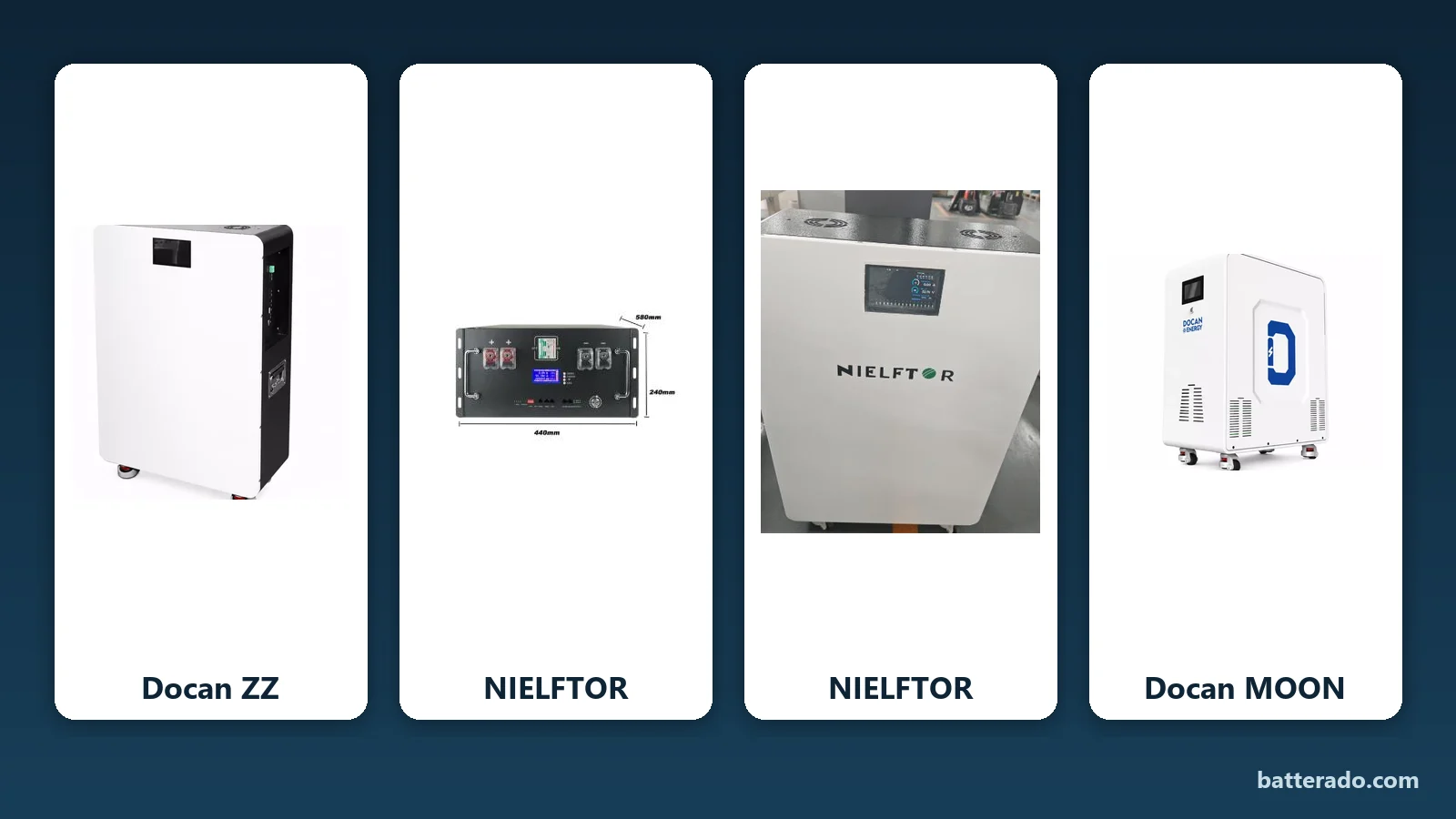
Home storage differs not only in capacity but also in how you work with it: one unit hangs on a wall, another slides into a rack, a third stands in a cabinet and a fourth rolls to wherever it is needed. All four designs use LiFePO4 cells at 51.2 V, so the real differences are placement, expansion and control.
How to choose: location first, capacity second
Capacity follows from the daily PV surplus and the evening consumption; the design follows from where the battery will stand. A technical room with a free wall, a garage, a cellar, a 19″ cabinet or a yard beside the house: each favours a different shape. On every product page it pays to check a few data points:
- dimensions and weight from the product page, to plan the route from the unloading point to the installation spot and the load capacity of the wall or floor,
- ingress protection (IP): IP65 suits outdoor installation, lower ratings suit indoor rooms,
- cabling and communication: a 48 V inverter is paired with a 51.2 V battery and a CAN or RS485 interface from the list of compatible inverters,
- expansion: the number of units that can be connected in parallel,
- display and app for checking the status on site and on a phone.
Wall-mounted battery: saves space next to the inverter
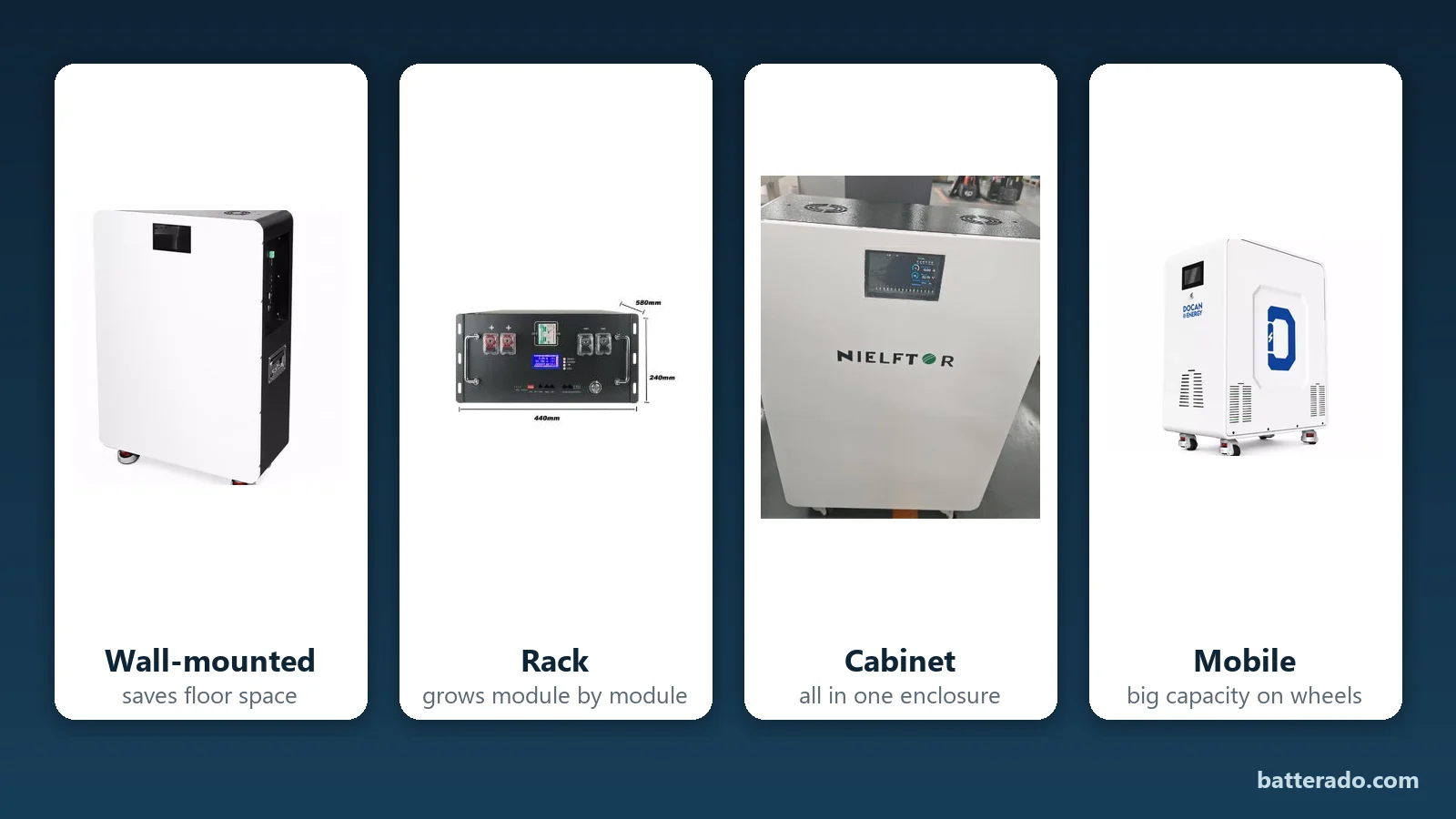
The wall-mounted design suits a technical room, boiler room or garage with a free wall beside the inverter. The battery takes up little floor area and the cables to the inverter stay short. Some models can also stand on the floor.
Docan ZZ 16 kWh (51.2 V / 314 Ah) is a wall or floor cabinet measuring 53.5 × 24.2 × 75.2 cm with a net weight of 126 kg, a touch display, RS485, RS232 and CAN interfaces, and parallel connection of up to 16 sets. For an outdoor wall or a carport there is the Felicity FLB48100WG1-H: 5.12 kWh, IP65, 650 × 450 × 174 mm, 48.5 kg, CAN, RS485, Wi-Fi and Bluetooth, up to 32 units in parallel. A depth of 17.4 cm keeps it slim enough for a narrow wall.
Rack battery: modular and uniform
A 19″ rack suits anyone building storage from several units stacked above each other. The modules share one width, the cabling stays tidy and another unit simply goes into the same cabinet. It fits a technical room or a cellar.
The NIELFTOR 10.24 kWh (51.2 V / 200 Ah) measures 580 × 440 × 240 mm, weighs 78.95 kg, has a 200 A BMS, CAN and RS485 interfaces and Bluetooth and Wi-Fi monitoring; up to 16 units can be connected in parallel. For more capacity in a single module there is the Gobel Power GP-SR1-18K Premium: 18.227 kWh at 51.2 V / 356 Ah, 482.6 × 241.3 × 773 mm, 130 kg, EVE cells, RS485, RS232 and CAN communication, up to 63 units in parallel and a 10-year warranty. Its IP21 rating matches the indoor rooms where racks normally stand.
Cabinet battery: a complete unit in one enclosure
A cabinet houses the cells and the battery management in one closed body, so it is installed as a single unit. It suits a garage, a hallway or business premises where a tidy, enclosed storage is valued.
The NIELFTOR cabinet 10.24 kWh measures 790 × 530 × 318 mm and has a net weight of 82 kg. It contains a 200 A BMS protecting against overcurrent, overcharge, over-discharge and short circuit, communicates via CAN and RS485, reports its status over Bluetooth and Wi-Fi and can be paralleled up to 16 units. Its capacity of 10.24 kWh equals that of the rack version in the same series, so the choice depends on whether a rack cabinet or free floor space is available.
Mobile battery: large capacity, easy to relocate
Wheels give a large battery a practical advantage: it can be rolled into place, moved for servicing or repositioned when a technical room is rearranged. The mobile designs include some of the highest capacities in a single unit.
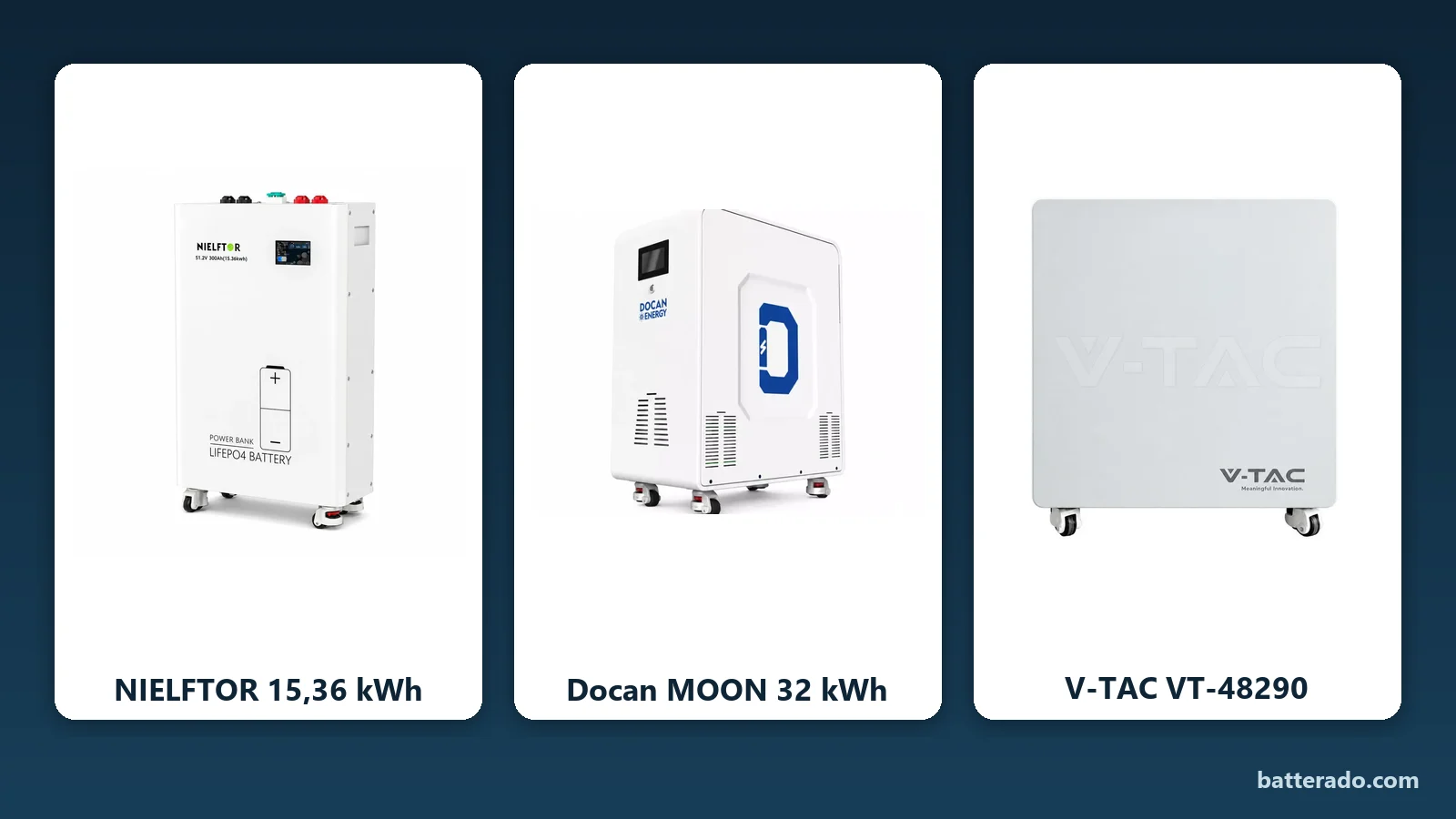
- NIELFTOR mobile 15.36 kWh: 51.2 V / 300 Ah, cabinet 495 × 263 × 780 mm, net weight 118 kg, multilingual touch display, CAN and RS485, up to 16 units in parallel.
- Docan MOON 32 kWh: 51.2 V / 628 Ah, 16S2P configuration, cabinet 912 × 420 × 715 mm, net weight 240 kg, 5-inch touch display, Wi-Fi, Bluetooth and 2 A active balancing, up to 16 units in parallel.
- V-TAC VT-48290: 16.07 kWh, IP65, built-in aerosol fire-suppression module, TBESS app over Bluetooth and Wi-Fi, CAN and RS485; discharging from −20 to +60 °C, charging from 0 to +55 °C.
Outdoor IP65 in any design
Ingress protection is not tied to shape. The wall-mounted Felicity and the mobile V-TAC are both rated IP65, so choosing outdoor storage need not mean a compromise on capacity. For outdoor installation, also check the charging and discharging temperature range stated on each product page.
Designs at a glance
| Design | Typical location | Examples from our range | Main strength |
|---|---|---|---|
| Wall-mounted | technical room, garage, outdoor wall (IP65) | Docan ZZ 16 kWh, Felicity FLB48100WG1-H | little floor space, short cabling |
| 19″ rack | technical room, cabinet, cellar | NIELFTOR 10.24 kWh, Gobel Power GP-SR1-18K | modular build, uniform cabling |
| Cabinet | garage, hallway, business premises | NIELFTOR cabinet 10.24 kWh | a complete unit in a closed cabinet |
| Mobile | garage, cellar, yard (IP65) | NIELFTOR 15.36 kWh, Docan MOON 32 kWh, V-TAC VT-48290 | large capacity, easy relocation |
Expansion and control
All the models above can be expanded by connecting further units in parallel; the maximum number is stated on the product page (from 16 to 63 units). The display on the battery makes it easy to set the protocol for the inverter, and the Bluetooth or Wi-Fi app shows the status on a phone.
In short
A wall-mounted battery saves floor space, a rack battery builds storage module by module, a cabinet battery delivers a closed unit and a mobile battery combines large capacity with easy relocation. Our guide Tomo will help you choose directly on the website, or send us a question using the “Ask a question” button on the product page.