





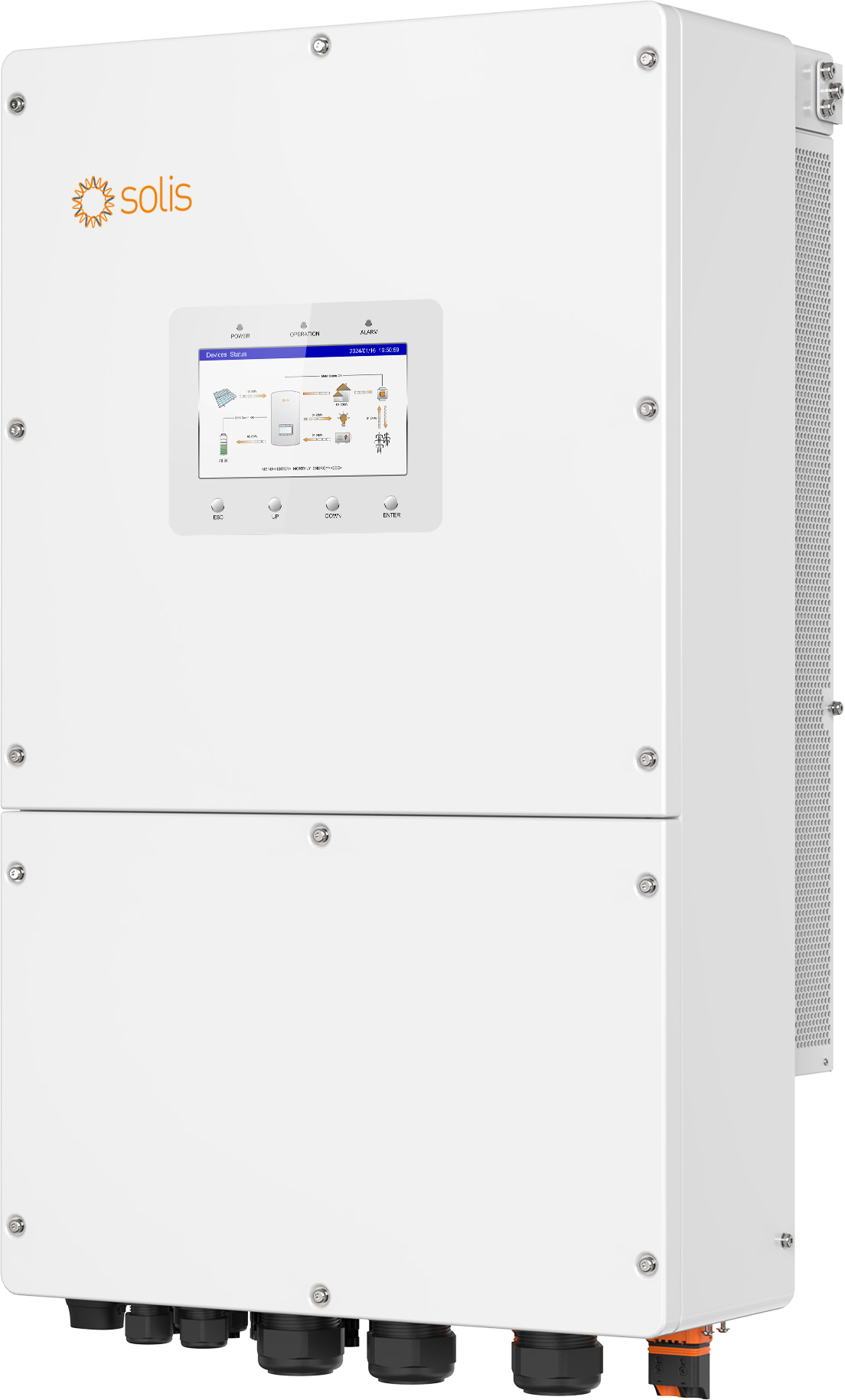
Description
Technical specifications
| Manufacturer | Solis / Ginlong Technologies |
|---|---|
| Manufacturer model | S6-EH3P30K-H |
| Device type | Three-phase hybrid inverter for PV and HV battery |
| Offered configuration | DC switch, Wi-Fi/LAN, 7″ LCD, meter and DC/AC Type II SPD |
| Rated AC output | 30000 W |
| Maximum DC voltage | 1000 V |
| Rated DC voltage | 600 V |
| Storage capacity | In kWh according to selected battery system |
| Battery matching | Exact model, module count, voltage, BMS, firmware and current capability |
| Battery communication | CAN /RS485 |
| Grid connection | 3/N/PE; 220/380 V; 230/400 V |
| Grid frequency | 50 /60 Hz |
| Power factor | >0.99; 0.8 leading /lagging |
| THDi | <3 % |
| Keys | ESC /UP /DOWN /ENTER |
| Status LEDs | POWER /OPERATION /ALARM |
| App roles | Installer /Owner |
| Operating modes | Self Use /Selling First /Off Grid /Peak Shaving |
| Grid charging | Allow Grid Charging |
| Time scheduling | 6 charging and 6 discharging windows |
| Backup reserve | 5–95 % SOC; default 80 % |
| Default maximum charge | 100 % SOC |
| SOC setting order | Force Charge <Over-discharge <Recovery |
| Export measurement calibration | −500…+500 W; default 20 W |
| Smart port — function selection | Genset input /AC coupled /Smart load output |
| CT orientation | Arrow towards grid |
| BMS CAN RJ45 | 4 CAN-H /5 CAN-L |
| BMS RS485 RJ45 | 3 B /6 A |
| Meter RJ45 | 1 A /2 B |
| Eastron terminals | 13 B /14 A |
| DRM — remote shutdown | RJ45 5 /6; open shuts down within 5 s |
| PV conductors | 4–6 mm²; recommended 4 mm² |
| PV stripping | 7 ±0.5 mm |
| AC stripping | 13 mm |
| Ingress protection | IP66 |
| Operating temperature | −25…+60 °C |
| Operating humidity | 0–100 % RH |
| Estimated delivery | 2–3 days |
| Maximum AC apparent output | 30000 VA |
| Rated backup output | 30000 W |
| Peak backup output /duration | 48000 VA /2 s |
| Backup transfer | <10 ms |
| Maximum imbalance power per phase per manual | 33% rated power |
| THDv linear load | <2 % |
| MPPT count | 3 |
| String count | 6 |
| Strings per MPPT | 2 |
| Input current per MPPT | 40 A |
| Current per string | 20 A |
| Short-circuit current per MPPT | 60 A |
| Maximum input power per MPPT | 24 kW |
| Recommended PV array rating | 60 kWp |
| Maximum usable PV power | 60 kW |
| Start-up voltage | 180 V |
| MPPT range | 150–850 V |
| Full-load MPPT range | 500–850 V |
| Battery type | Compatible HV Li-ion battery system with BMS |
| Battery voltage | 150–800 V |
| Battery port count | 2 |
|---|---|
| Maximum battery-port current | 70 A +70 A |
| Current with combined inputs | Up to 140 A in the corresponding battery arrangement |
| Maximum total charge /discharge power | 33 /33 kW |
| Maximum charge /discharge power per port | 33 /33 kW |
| Battery reference point 150 V | 30 A /4.5 kW |
| Battery reference point 310 V | 56 A /17.36 kW |
| Battery reference point 320 V | 70 A /22.4 kW |
| Battery operating limits | Actual U×I, BMS, model-specific port and total-system limits |
| One battery — one port | DC1 +BMS1 |
| Two batteries | Each with its own DC input and BMS connection |
| One battery — two ports | DC1 and DC2 connection according to diagram, communication BMS1 |
| Battery-bank settings | Count 1–2, model, connection method, current and SOC of each bank |
| Rated AC current at 380/400 V | 45.6 /43.3 A |
| Maximum AC passthrough at 380/400 V | 91.2 /86.6 A |
| Grid voltage range | 304–460 V |
| Grid frequency range | 45–55 /55–65 Hz |
| Generator — maximum input power | 30 kW |
| Generator — current at 380/400 V | 45.6 /43.3 A |
| Generator — power selection per datasheet | 20–100% rated power according to design |
| Maximum efficiency | 97.8 % |
| European efficiency | 97.4 % |
| PV →battery efficiency | 98.5 % |
| Battery ↔AC efficiency | 97.5 % |
| MPPT efficiency | 99.9 % |
| User interface | 7.0″ LCD /Bluetooth /SolisCloud APP |
| Bluetooth | BDR /EDR /BLE; 2.402–2.480 GHz; 8 dBm |
| App sections | Home /Info /Alarm /Settings |
| Operating information | PV /Battery /Grid /Load /Inverter; SOC /SOH; energy history and generator yield |
| Diagnostics | Current and historical alarms |
| Initial settings | Time, CT/meter, grid code, operating mode and battery banks |
| Over-discharge SOC | 5–40 %; default 20 % |
| Force-charge SOC | From 4% to selected over-discharge SOC |
| Discharge recovery | 1–20 percentage points above over-discharge SOC |
| Peak Shaving — settings | With battery reserve enabled; default limit 2×rated power |
| Generator — start /stop SOC | 1–95 % /35–100 % |
| AC coupling — start /stop SOC | 1–95 % /35–100 % |
| Included standard meter | Eastron SDM630MCT V2 |
| Standard CTs | 3 ×ESCT-T50; 300 A /5 A |
| CT cable length | 4 m |
| Reference CT ratio | 60; according to actual CTs |
| CT — HM terminals | White S1:1/3/5; black S2:2/4/6 |
| External RS485 | 5 A /4 B |
| GEN — start contact | G-V 7/8, voltage-free contact according to diagram |
| Generator at Grid — status signal | DI through matching external 220 VAC /5 VDC converter and system-specific diagram |
| Communication glands | COM1/COM2:6 mm; COM3/COM4:2 mm |
| Parallel system | Standard up to 6 units according to diagram; batteries assigned to individual inverters |
| Parallel connection | P-B →P-A; shielded STP CAT5; normally 3–5 m between units |
| Parallel-system addresses | Master 1; Slave 2–6 |
| Parallel bus termination | Endpoint DIPs ON, intermediate OFF according to diagram |
| Parallel AC paths above 2 units | Grid/Backup cable-length difference to busbar within 10% |
| Battery conductors | 10–25 mm² |
| Battery — internal /external stripping | 15 ±1 /18 ±1 mm |
| Battery connector — torque | 4 ±0.1 Nm |
| Battery fuses | 2 ×1000 V /100 A |
| Reference battery protection | 80 A per battery according to design |
| AC Grid conductors | 50 mm² |
| AC Backup /Smart conductors | 20–25 mm² |
| PE bar — conductor | 33 mm² |
|---|---|
| AC terminals — torque | 28.2 Nm |
| PE bar — torque | 20.3 Nm |
| AC glands — torque | 7–7.5 Nm |
| External earth | M5 /3.5 Nm |
| Reference AC protection | Grid 4p160 A; Backup/Smart 4p80 A according to design |
| Mounting clearances | 500 mm around; 1000 mm above floor and service access according to diagram |
| Mounting | Vertical wall mounting up to ±5° |
| Mounting structure — design load | ≥292 kg |
| Bracket — overall width /height | 497 /452.5 mm |
| Dimensions W ×H ×D | 530 ×880 ×290 mm |
| Weight | 73 kg |
| Altitude | 4000 m |
| Design DC voltage at 2000/2700/3000/3500/4000 m | 1000 /1000 /981 /925 /875 V |
| Cooling | Intelligent redundant fan cooling |
| Noise per manual | <65 dB(A) |
| Night consumption | <35 W |
| Surge protection | DC Type II /AC Type II |
| AFCI 2.0 | Optional family configuration |
| Package — main parts | Inverter, backplate, quick guide, S2-WL-ST logger, meter and three CTs |
| Package — fasteners | 4 fastening screws, 5 expansion bolts, 2 handles |
| Package — connectors and communication | 8 ×PV; 13 ×OT; 2 ×BAT; 11 ×RJ45; 1 ×CAN 3 m |
Generation and storage for business
Solis S6-EH3P30K-H connects commercial PV, compatible high-voltage batteries and three-phase demand. Rated 30 kW describes instantaneous inverter output; the chosen battery system determines stored kWh. Design estimates simultaneous demand, appliance starting and required runtime. Batterado helps match power, capacity, metering and supported wiring into a working system.
PV array with independent MPPTs
3 independent trackers connect 6 strings, two per MPPT. Tracker current reaches 40 A, string current 20 A and MPPT short-circuit current 60 A. Recommended array is 60 kWp and maximum usable input 60 kW. Start-up is 180 V, MPPT range 150–850 V and full-load range 500–850 V. Each MPPT accepts up to 24 kW. String voltage and module currents are checked for local conditions and roof orientations.
Dual battery ports and actual operating power
Two independent inputs work with compatible 150–800 V HV Li-ion batteries, each up to 70 A. This model’s total charge and discharge power reaches 33 kW, with up to 33 kW per port. Family reference points are 150 V/30 A, 310 V/56 A and 320 V/70 A. Actual operation respects voltage times current, BMS limits, per-port output and total inverter limit. Battery kWh, module count, firmware and temperature conditions are selected for the exact battery.
Three supported battery wiring arrangements
One battery on one input uses DC1 and BMS1 communication. Two independent batteries use their own power and communication connections. A suitable battery system can connect one battery to both DC inputs following the original diagram and use BMS1; this arrangement supports combined current up to 140 A within model power limits. Commissioning sets bank count, actual wiring arrangement, battery model, currents and SOC. Banks can use individual settings.
Backup demand and short peaks
Backup output offers rated 30 kW and briefly 48 kVA for two seconds. Manufacturer backup transfer is less than 10 ms; linear-load THDv is below 2%. Design allocates appliances across phases according to operating and starting characteristics and backup-output specifications. Battery power and SOC match the required demand. The backup distribution board connects to Backup and utility supply to Grid.
Overview on 7″ LCD and in the app
The seven-inch LCD and ESC, UP, DOWN and ENTER keys support local operation. POWER, OPERATION and ALARM indicate status. Bluetooth SolisCloud distinguishes Installer and Owner; included Wi-Fi/LAN supports remote monitoring. Home displays energy flows; Info covers PV, battery, grid, loads and inverter including SOC/SOH and energy history. Alarm shows current and historical events. Initial setup covers time, metering, grid code, operating mode and battery banks.
Scheduled charging and demand control
Self Use supplies appliances and battery first, Selling First prioritises export after loads and Off Grid serves designed independent systems. Six charging and six discharging windows control the battery by time, current and target SOC. Allow Grid Charging enables recovery at Force Charge SOC or when PV is insufficient during a charge window. A 5–95% SOC reserve keeps backup energy available. Peak Shaving with reserve enabled uses the configured import limit and actual system capability.
Smart port and generator matched to system design
Select Smart port as Genset input, AC coupled or Smart load output according to the project. This model accepts up to 30 kW generator input. A generator works with configured charge-start and charge-stop SOC; G-V uses voltage-free start contact 7/8. A generator at Grid uses the appropriate ATS wiring and DI status signal with an external 220 VAC/5 VDC converter following the original diagram. AC coupling uses matching frequency and SOC settings for the existing PV source.
Grid metering and separate communications
The offered Meter version uses Eastron SDM630MCT V2 and ESCT-T50 300 A/5 A CTs with 4 m cables. CT arrows point towards grid; standard ratio is 60. HM pins 1/3/5 connect white S1,2/4/6 black S2. Meter RJ45 uses 1 A and 2 B, BMS CAN4 H and 5 L, BMS RS4856 A and 3 B. External RS485 uses 5 A and 4 B. Metering, BMS and parallel communication have dedicated interfaces. Meter type, CT ratio and metering location match the actual installation.
Parallel expansion and IP66 installation
A standard parallel system connects up to six units through P-A/P-B with shielded STP CAT5, normally 3–5 m between units. Master address is 1, others 2–6, with parallel mode enabled before commissioning. Batteries are assigned to individual inverters, endpoint DIPs follow the diagram and earthing uses a common point. Above two units, Grid/Backup cable-length differences to busbar stay within 10%. The 73 kg enclosure mounts vertically with airflow,500 mm clearances and 1000 mm height above floor.
Equipment and completing the plant
The package includes inverter, backplate, four fastening screws, five expansion bolts, two handles, eight pairs of PV connectors, thirteen OT terminals, two battery connectors, one 3 m CAN cable and eleven RJ45s. The offered configuration adds S2-WL-ST, meter and CTs. Manual AC Grid size is 50 mm², Backup/Smart 20–25 mm², battery 10–25 mm² and external earth M5. Selected modules, mounting accessories, compatible batteries, cables and project protection complete the system. Original diagrams and the technical overview connect component selection.
Downloads
- Solis HV 30–50 kW — datasheet V3.8
- Solis HV 30–50 kW — European manual V1.2
- Complete product overview — Markdown
AI search description
Solis S6-EH3P30K-H — 30 kW hybrid inverter, 3 MPPTs, dual HV battery ports. Solis S6-EH3P30K-H connects commercial PV, compatible high-voltage batteries and three-phase demand. Rated 30 kW describes instantaneous inverter output; the chosen battery system determines stored kWh. Design estimates simultaneous demand, appliance starting and required runtime. Batterado helps match power, capacity, metering and supported wiring into a working system. Two independent inputs work with compatible 150–800 V HV Li-ion batteries, each up to 70 A. This model’s total charge and discharge power reaches 33 kW, with up to 33 kW per port. Family reference points are 150 V/30 A, 310 V/56 A and 320 V/70 A. Actual operation respects voltage times current, BMS limits, per-port output and total inverter limit. Battery kWh, module count, firmware and temperature conditions are selected for the exact battery.
Manufacturer: Solis / Ginlong Technologies; Manufacturer model: S6-EH3P30K-H; Device type: Three-phase hybrid inverter for PV and HV battery; Offered configuration: DC switch, Wi-Fi/LAN, 7″ LCD, meter and DC/AC Type II SPD; Rated AC output: 30000 W; Maximum DC voltage: 1000 V; Rated DC voltage: 600 V; Storage capacity: In kWh according to selected battery system; Battery matching: Exact model, module count, voltage, BMS, firmware and current capability; Battery communication: CAN /RS485; Grid connection: 3/N/PE; 220/380 V; 230/400 V; Grid frequency: 50 /60 Hz; Power factor: >0.99; 0.8 leading /lagging; THDi: <3 %; Keys: ESC /UP /DOWN /ENTER; Status LEDs: POWER /OPERATION /ALARM; App roles: Installer /Owner; Operating modes: Self Use /Selling First /Off Grid /Peak Shaving; Grid charging: Allow Grid Charging; Time scheduling: 6 charging and 6 discharging windows; Backup reserve: 5–95 % SOC; default 80 %; Default maximum charge: 100 % SOC; SOC setting order: Force Charge <Over-discharge <Recovery; Export measurement calibration: −500…+500 W; default 20 W; Smart port — function selection: Genset input /AC coupled /Smart load output; CT orientation: Arrow towards grid; BMS CAN RJ45: 4 CAN-H /5 CAN-L; BMS RS485 RJ45: 3 B /6 A; Meter RJ45: 1 A /2 B; Eastron terminals: 13 B /14 A; DRM — remote shutdown: RJ45 5 /6; open shuts down within 5 s; PV conductors: 4–6 mm²; recommended 4 mm²; PV stripping: 7 ±0.5 mm; AC stripping: 13 mm; Ingress protection: IP66; Operating temperature: −25…+60 °C; Operating humidity: 0–100 % RH; Estimated delivery: 2–3 days; Maximum AC apparent output: 30000 VA; Rated backup output: 30000 W; Peak backup output /duration: 48000 VA /2 s; Backup transfer: <10 ms; Maximum imbalance power per phase per manual: 33% rated power; THDv linear load: <2 %; MPPT count: 3; String count: 6; Strings per MPPT: 2; Input current per MPPT: 40 A; Current per string: 20 A; Short-circuit current per MPPT: 60 A; Maximum input power per MPPT: 24 kW; Recommended PV array rating: 60 kWp; Maximum usable PV power: 60 kW; Start-up voltage: 180 V; MPPT range: 150–850 V; Full-load MPPT range: 500–850 V; Battery type: Compatible HV Li-ion battery system with BMS; Battery voltage: 150–800 V; Battery port count: 2; Maximum battery-port current: 70 A +70 A; Current with combined inputs: Up to 140 A in the corresponding battery arrangement; Maximum total charge /discharge power: 33 /33 kW; Maximum charge /discharge power per port: 33 /33 kW; Battery reference point 150 V: 30 A /4.5 kW; Battery reference point 310 V: 56 A /17.36 kW; Battery reference point 320 V: 70 A /22.4 kW; Battery operating limits: Actual U×I, BMS, model-specific port and total-system limits; One battery — one port: DC1 +BMS1; Two batteries: Each with its own DC input and BMS connection; One battery — two ports: DC1 and DC2 connection according to diagram, communication BMS1; Battery-bank settings: Count 1–2, model, connection method, current and SOC of each bank; Rated AC current at 380/400 V: 45.6 /43.3 A; Maximum AC passthrough at 380/400 V: 91.2 /86.6 A; Grid voltage range: 304–460 V; Grid frequency range: 45–55 /55–65 Hz.
Generator — maximum input power: 30 kW; Generator — current at 380/400 V: 45.6 /43.3 A; Generator — power selection per datasheet: 20–100% rated power according to design; Maximum efficiency: 97.8 %; European efficiency: 97.4 %; PV →battery efficiency: 98.5 %; Battery ↔AC efficiency: 97.5 %; MPPT efficiency: 99.9 %; User interface: 7.0″ LCD /Bluetooth /SolisCloud APP; Bluetooth: BDR /EDR /BLE; 2.402–2.480 GHz; 8 dBm; App sections: Home /Info /Alarm /Settings; Operating information: PV /Battery /Grid /Load /Inverter; SOC /SOH; energy history and generator yield; Diagnostics: Current and historical alarms; Initial settings: Time, CT/meter, grid code, operating mode and battery banks; Over-discharge SOC: 5–40 %; default 20 %; Force-charge SOC: From 4% to selected over-discharge SOC; Discharge recovery: 1–20 percentage points above over-discharge SOC; Peak Shaving — settings: With battery reserve enabled; default limit 2×rated power; Generator — start /stop SOC: 1–95 % /35–100 %; AC coupling — start /stop SOC: 1–95 % /35–100 %; Included standard meter: Eastron SDM630MCT V2; Standard CTs: 3 ×ESCT-T50; 300 A /5 A; CT cable length: 4 m; Reference CT ratio: 60; according to actual CTs; CT — HM terminals: White S1:1/3/5; black S2:2/4/6; External RS485: 5 A /4 B; GEN — start contact: G-V 7/8, voltage-free contact according to diagram; Generator at Grid — status signal: DI through matching external 220 VAC /5 VDC converter and system-specific diagram; Communication glands: COM1/COM2:6 mm; COM3/COM4:2 mm; Parallel system: Standard up to 6 units according to diagram; batteries assigned to individual inverters; Parallel connection: P-B →P-A; shielded STP CAT5; normally 3–5 m between units; Parallel-system addresses: Master 1; Slave 2–6; Parallel bus termination: Endpoint DIPs ON, intermediate OFF according to diagram; Parallel AC paths above 2 units: Grid/Backup cable-length difference to busbar within 10%; Battery conductors: 10–25 mm²; Battery — internal /external stripping: 15 ±1 /18 ±1 mm; Battery connector — torque: 4 ±0.1 Nm; Battery fuses: 2 ×1000 V /100 A; Reference battery protection: 80 A per battery according to design; AC Grid conductors: 50 mm²; AC Backup /Smart conductors: 20–25 mm²; PE bar — conductor: 33 mm²; AC terminals — torque: 28.2 Nm; PE bar — torque: 20.3 Nm; AC glands — torque: 7–7.5 Nm; External earth: M5 /3.5 Nm; Reference AC protection: Grid 4p160 A; Backup/Smart 4p80 A according to design; Mounting clearances: 500 mm around; 1000 mm above floor and service access according to diagram; Mounting: Vertical wall mounting up to ±5°; Mounting structure — design load: ≥292 kg; Bracket — overall width /height: 497 /452.5 mm; Dimensions W ×H ×D: 530 ×880 ×290 mm; Weight: 73 kg; Altitude: 4000 m; Design DC voltage at 2000/2700/3000/3500/4000 m: 1000 /1000 /981 /925 /875 V; Cooling: Intelligent redundant fan cooling; Noise per manual: <65 dB(A); Night consumption: <35 W; Surge protection: DC Type II /AC Type II; AFCI 2.0: Optional family configuration; Package — main parts: Inverter, backplate, quick guide, S2-WL-ST logger, meter and three CTs; Package — fasteners: 4 fastening screws, 5 expansion bolts, 2 handles; Package — connectors and communication: 8 ×PV; 13 ×OT; 2 ×BAT; 11 ×RJ45; 1 ×CAN 3 m.
Reviews
There are no reviews yet.