





Description
Technical specifications
| Model / product role | Fronius Symo GEN24 12.0 Plus SC; standalone hybrid inverter |
|---|---|
| AC — Rated power (P nom ) | 12,000 W |
| AC — Maximum output power | 12,000 W |
| AC — Rated apparent power | 12,000 VA |
| AC — Nominal mains voltage | 3 ~ NPE 220 V/380 V; 3 ~ NPE 230 V/400 V |
| AC — Grounding systems | TN-S; TN-C-S |
| AC — Minimum mains voltage | 154 V |
| AC — Maximum mains voltage | 280 V |
| AC — Maximum output current | 18.5 A |
| AC — Rated output current (at 230 V) | 17.4 A |
| AC — Current (inrush) | 9.9 A/4 ms |
| AC — Nominal frequency | 50/60 Hz |
| AC — Initial symmetrical short-circuit current/phase I K " | 18.5 A |
| AC — Nominal frequency for Full Backup | 53/63 Hz |
| AC — Total harmonic distortion | < 3.5% |
| AC — Power factor cos phi | 0-1 (adjustable); 0.7-1 (recommended) |
| AC — Maximum output fault current / duration | 80.7 A/10 ms |
| PV — MPP voltage range; (at rated power) | 295 – 800 V |
| PV — Maximum connected load (P PV max ); Total; PV 1; PV 2 | 18,000 Wp; 14,000 Wp; 9000 Wp |
| PV — Maximum processable PV power; Total; PV 1; PV 2 | 12,360 Wp; 12,360 Wp; 8600 Wp |
| PV — Maximum input voltage; (at 1000 W/m²/-10 °C in an open circuit) | 1000 V |
| PV — Minimum input voltage | 80 V |
| PV — Feed-in start voltage in grid operation | 80 V |
| PV — Maximum input current; PV 1; PV 2 | 28.0 A; 14.0 A |
| PV — Maximum short circuit current for module array (I SC PV ); PV 1; PV 2 | 40 A; 20 A |
| PV — Maximum total short circuit current for module array; (I SC PV1 + I SC PV2 = I SC max ) | 60 A |
| PV — Faulted module current to other modules — PV1/PV2 | 40 A / 20 A; current from the inverter itself to the PV side: 0 A; manual note3 |
| PV — Number of inputs—PV 1 | 2 |
| PV — Number of inputs—PV 2 | 1 |
| PV — Maximum capacity of the PV generator against ground; Total; PV 1; PV 2 | 2400 nF; 1860 nF; 1200 nF |
| PV — Limit value of the insulation resistance test between module array and ground (on delivery) | 100 kΩ |
| PV — Adjustable range of insulation resistance test between module array and ground | 10-10,000 kΩ |
| PV — Limit value and trip time of sudden residual fault current monitoring (on delivery) | 30/300 mA/ms; 60/150 mA/ms; 90/40 mA/ms |
| PV — Limit value and trip time of continuous residual fault current monitoring (on delivery) | 300/300 mA/ms |
| PV — Adjustable range of continuous residual current monitoring | 30-300 mA |
| PV — Cyclic repetition of the insulation resistance test (on delivery) | 24 h |
| Battery — Maximum voltage | 700 V |
| Battery — Minimum voltage | 160 V |
| Battery — Maximum current | 22 A |
| Battery — Maximum output | 11,682 W |
| Battery — DC inputs | 1 |
| PV Point — Maximum output power | 4255 W (for 5 s) |
| PV Point — Nominal output power | 3000 W |
| PV Point — Rated output current | 13 A |
| PV Point — Nominal mains voltage | 1 ~ NPE 220 V/230 V/240 V |
| PV Point — Nominal frequency | 53/63 Hz |
| PV Point — Switching time | ~ 15 s |
| PV Point — Power factor cos phi | 0 – 1 |
| Full Backup — Maximum output power | 12,765 W (for 5 s) |
| Full Backup — Maximum output power (per phase) | 4255 W (for 5 s) |
| Full Backup — Nominal output power | 12,000 W |
| Full Backup — Nominal output power (per phase) | 4133 W; within total inverter rated power |
| Full Backup — Rated output current (per phase) | 17.4 A |
| Full Backup — Nominal mains voltage | 3 ~ NPE 220 V/380 V; 3 ~ NPE 230 V/400 V |
| Full Backup — Nominal frequency for Full Backup | 53/63 Hz |
|---|---|
| Full Backup — Switching time | ~ 10 s |
| Full Backup — Switching time with ; Rapid switch mode | < 20 ms; subject to enabled mode and configuration in current manual |
| Full Backup — Power factor cos phi | 0 – 1 |
| Communication — WiFi SMA-RP connection; ( FCC ID: QKWPILOT1/IC 12270A-PILOT1) | 802.11b/g/n (WPA, WPA2); Frequency: 2.4 GHz |
| Communication — Ethernet (LAN) | RJ 45, 10/100 Mbit |
| Communication — Wired shutdown (WSD) | Max. 28 devices/WSD chain; Max. distance between two devices = 100 m |
| Communication — Modbus RTU SunSpec (2x) | RS485 2-wire |
| Communication — Battery connection | Modbus O/RJ 45/12 V power supply |
| Communication — Voltage level of digital inputs | Low: min. 0 V-max. 1.8 V; High: min. 4.5 V-max. 28.8 V |
| Communication — Input currents of digital inputs | depending on the input voltage; input resistance = 70 kOhm |
| Communication — Total power for digital output (with internal supply) | 6 W at 12 V |
| Communication — Power per digital output; (with external supply) | 1 A at >12.5 V-24 V; (max. 3 A in total) |
| Communication — Datalogger/web server | Integrated |
| Construction — Maximum efficiency | 98.2% |
| Construction — Europ. efficiency (U mpp nom ) | 97.9% |
| Construction — Europ. efficiency (U mpp max ) | 97.5% |
| Construction — Europ. efficiency (U mpp min ) | 97.0% |
| Construction — Self-consumption at night | ≤ 10 W |
| Construction — Cooling | Controlled forced-air ventilation |
| Construction — Ingress protection rating | IP 66 |
| Construction — Dimensions H × W × D | 595 × 529 × 180 mm |
| Construction — Weight | 22.8 kg |
| Construction — Inverter topology | Non-insulated, no transformer |
| Construction — Permitted ambient temperature | -25 °C – +60 °C |
| Construction — Permissible humidity | 0-100% (incl. condensation) |
| Construction — EMC emission class; (in accordance with IEC 61000 ‑ 6 ‑ 2, IEC 61000 ‑ 6 ‑ 3) | B |
| Construction — DC/AC overvoltage category; (in accordance with IEC 62109-1) | 2/3 |
| Construction — Pollution degree | 2 |
| Construction — Sound pressure level | 47 dB(A) (ref. 20 µPA) |
| Construction — Protective class | 1 |
| Protection — DC isolation measurement | Warning/shutdown at R ISO < 100 kOhm |
| Protection — Overload performance | Operating point shift, power limit |
| Protection — DC disconnector | Integrated |
| Protection — RCMU | Integrated |
| Protection — RCMU classification | The software class of the safety platform(s) is defined as a class B control function (single-channel with periodic self-test) in accordance with IEC 60730 Annex H. |
| Protection — Active anti-islanding method | Frequency point shift method |
| Protection — AFCI | Integrated |
| Protection — AFPE (AFCI) classification (according to IEC 63027) | = F-I-AFPE-1-3-1 ; Full coverage; Integrated; AFPE; 1 monitored string per input port; 3 input ports per channel (MPP1: 2, MPP2: 1); 1 monitored channel |
| MPPT trackers / usable range | 2; 80–800 V |
| Rated DC voltage | 610 V |
| PV Point without battery — minimum PV voltage | 150 V |
| Battery — supported product families | Fronius Reserva / Reserva Pro; BYD HVS/HVM, HVS+/HVM+; LG FLEX |
| Battery — pairing requirements | Actual capacity configuration, firmware, BMS profile and local approval per manufacturer |
| Full Backup — system components | Suitable battery, Fronius Smart Meter, external grid switching and settings per diagram |
| Full Backup — apparent phase power in datasheet | 4225 VA |
| Battery — maximum AC-coupled charging | 11682 W |
| PV / battery spring terminals | 2,5–10 mm² |
| AC spring / PE screw terminals | 1,5–10 mm² / 2,5–16 mm² |
| Weight including packaging | 28,0 kg |
| Installation altitude | 3000 m unrestricted / 4000 m with restricted voltage range |
| Recommended / maximum AC circuit protection | 32 A / 32 A |
| Standards listed in datasheet | IEC62109; IEC62116; IEC61727; IEC62909; VDE-AR-N4105; AS/NZS4777.2; EN50549; CEI0-21; G98; R25 |
| Country of manufacture | Austria |
One inverter for solar generation and storage
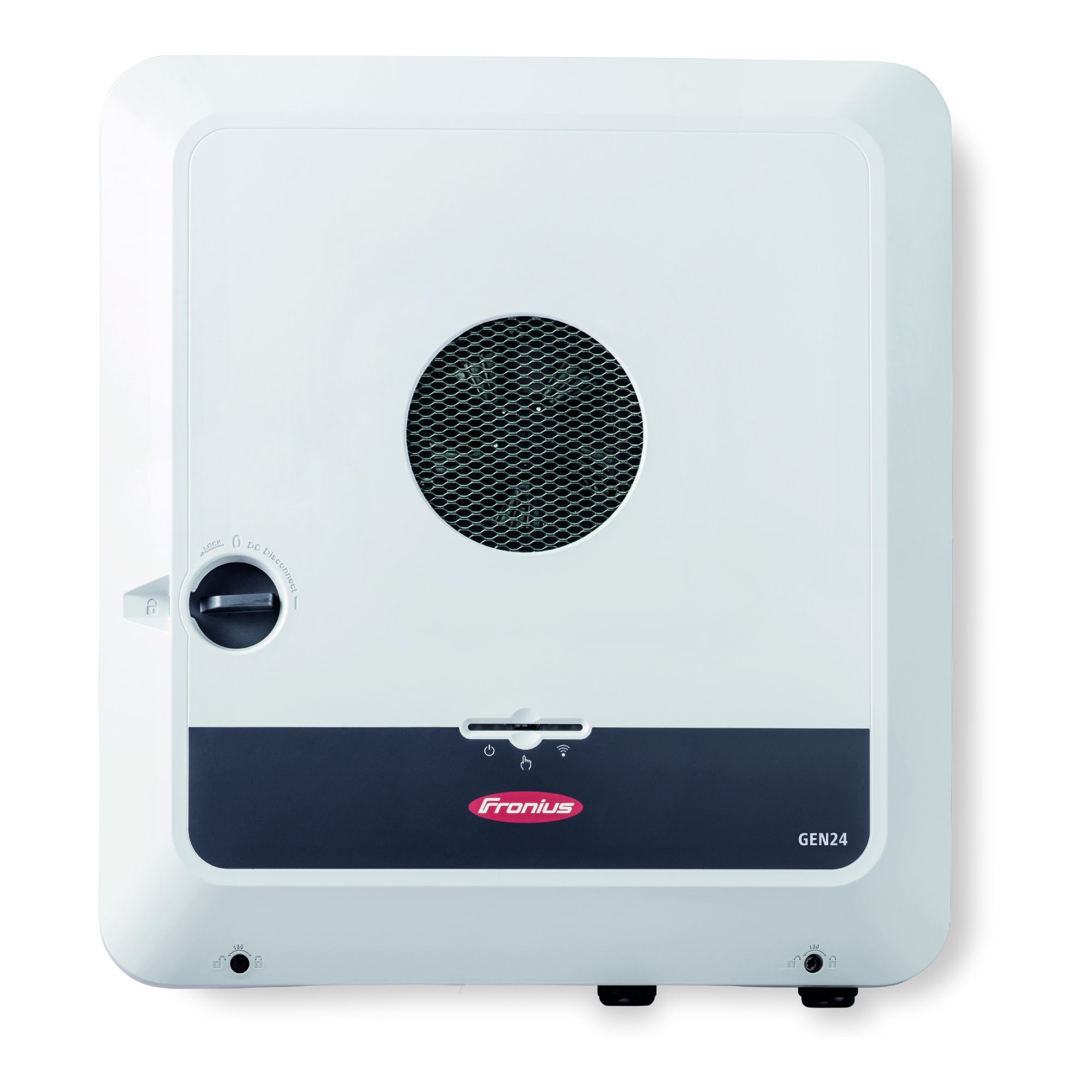
Fronius Symo GEN24 12.0 Plus SC connects three-phase photovoltaics to a high-voltage battery system. Its 12 kW rating describes the standalone inverter; the connected battery determines stored energy in kWh. Daytime generation can serve the building and charge storage for later use. Selecting panels, inverter, battery and installation components separately makes it possible to design a system for the actual roof, solar carport and operating pattern of a home or business.
Two MPPTs for an array up to 18 kWp
The two independent MPPTs accept 28 and 14 A, with three string connections arranged as 2+1. Model 12.0 supports an installed PV array up to 18 kWp. The upper table distinguishes installed array power from the DC power the inverter can process. String design considers module voltage, current and temperature effects. Maximum DC voltage is 1000 V, the usable MPP range is 80–800 V and the rated-power MPP range is 295–800 V. Panel selection and string orientation can therefore be matched to the actual electrical design.
Battery selection based on voltage and communication
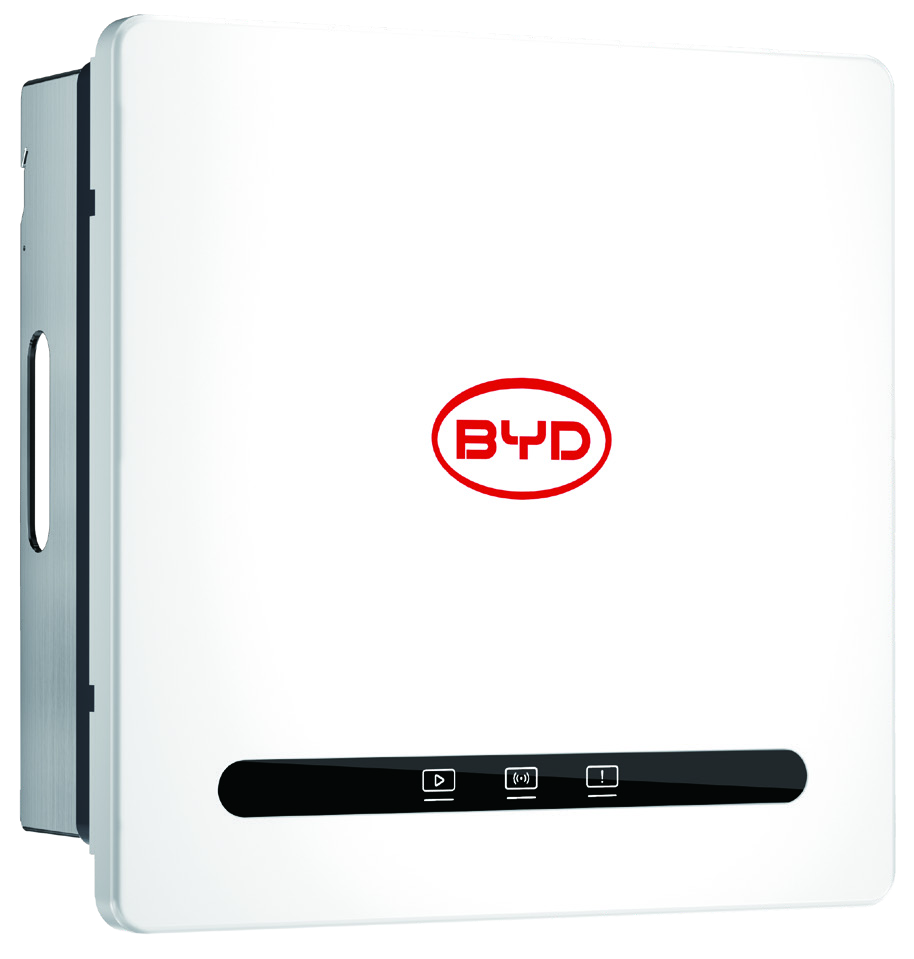
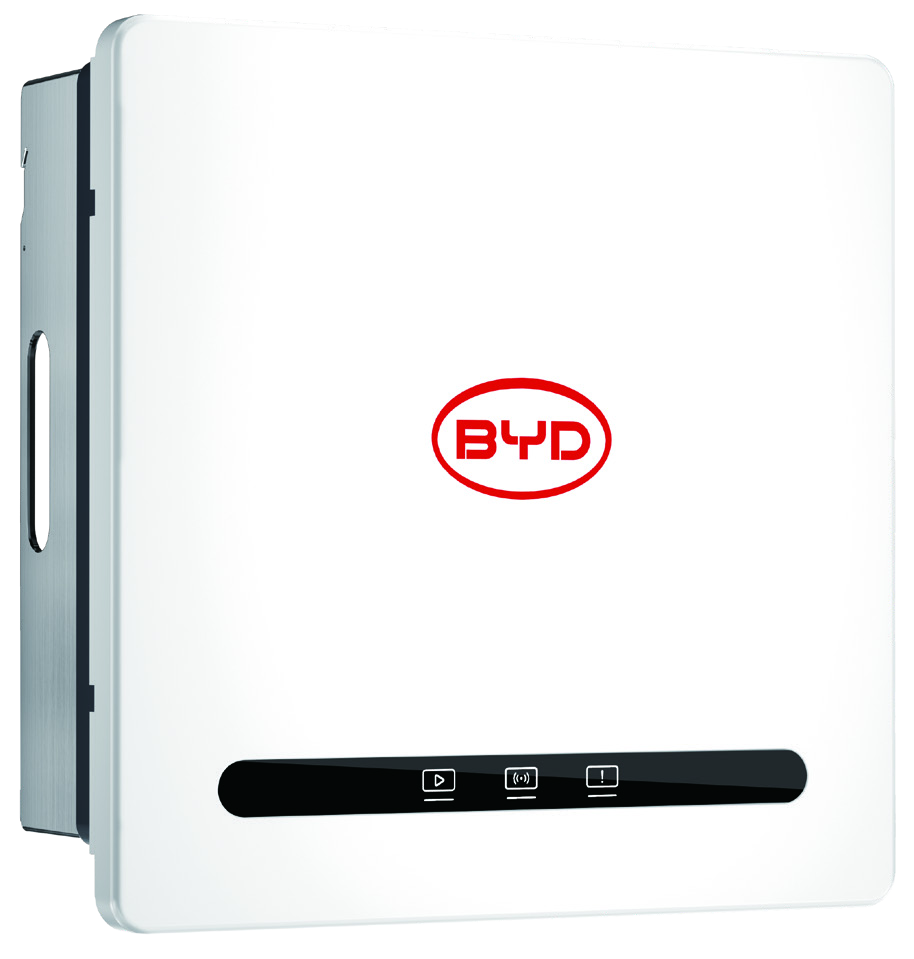
The battery input operates at 160–700 V and up to 22 A, with a maximum DC power of 11682 W depending on the connected battery. The datasheet lists Fronius Reserva, BYD Battery-Box HVS/HVM and HVS+/HVM+, and LG FLEX; the current manual also describes Fronius Reserva Pro. Selection includes the actual capacity configuration, supported firmware and communication profile. A shared connector alone does not establish interoperability. The battery and its controller are selected separately and their current capability is compared with the required charging and discharging power.
PV Point and three-phase Full Backup
PV Point supplies a basic single-phase backup circuit at up to 3000 W, with a standard switchover time of approximately 15 seconds. For PV Point operation without a battery, the manual specifies at least 150 V from the PV array. Full Backup uses a suitable connected battery, Fronius Smart Meter and external grid-separation switching components. Standard switchover takes approximately 10 seconds; the current manual also describes a rapid-switch mode subject to system configuration. Backup circuit design considers total power, phase loading and short motor starts. The table distinguishes continuous ratings and five-second peaks.
Open interfaces for energy management
An integrated datalogger and web server are complemented by WLAN, Ethernet and two RS485 interfaces. Integration options include Fronius Solar.web, Modbus TCP SunSpec, Modbus RTU SunSpec and the JSON-based Fronius Solar API. Digital inputs and outputs connect energy management and ripple-control equipment. A Fronius Smart Meter supports self-consumption and export management, while appropriate components such as Fronius Ohmpilot can extend the system. The technical overview identifies interface supply voltages, signal levels and output-current capabilities.
IP66 construction and detailed installation documents
The wall-mounted unit measures 595 × 529 × 180 mm and weighs 22.8 kg. IP66 protection and a declared ambient range of −25 to +60 °C support suitable indoor and outdoor installation following the manual. Active cooling controls airflow through the unit. Integrated functions include DC isolation, insulation measurement, residual-current monitoring and AFCI arc detection. Locally hosted downloads provide the exact datasheet and original manual, including the connection area, communication, cable cross-sections and backup switching diagrams. Battery, module and protective-device conditions are assessed separately.
Downloads
- Fronius GEN24 SC datasheet — April2026
- Original Fronius GEN24 SC manual — September2026
- Complete product overview — Markdown
AI search description
Fronius Symo GEN24 12.0 Plus SC is a standalone 12 kW three-phase hybrid AC inverter; stored energy in kWh is determined by a separate battery. Battery input 160–700 V,22 A,max.11682 W depending on the connected system. Match the exact battery model, capacity configuration, firmware and communication profile. Source-listed families: Fronius Reserva/Reserva Pro,BYD HVS/HVM/HVS+/HVM+,LG FLEX. Charging supports PV and AC coupling. PV array up to 18 kWp,DC1000 V,2 MPPT,28+14 A,2+1 strings,Isc 40+20 A,usable MPP80–800 V,rated-power MPP295–800 V. Combining modules or a solar carport requires cold-condition string-voltage and parallel-current calculations. Carport structure, modules, inverter and battery have separate system roles. PV Point 3 kW single-phase,standard≈15 s,at least 150 V PV when used without battery. Full Backup 12 kW three-phase,standard≈10 s,requires a suitable battery,Fronius Smart Meter and external grid switching; rapid mode depends on configuration and current manual. Evaluate total and per-phase power,starting peaks,runtime and energy separately. IP66,−25 to+60 °C,595×529×180 mm,22.8 kg,wall mounting; battery operating conditions are assessed separately. WLAN/LAN,2×RS485,Modbus SunSpec,Solar API,digital I/O and WSD. Intended for designed fixed home or business PV installations with storage and selected backup circuits.
Reviews
There are no reviews yet.