

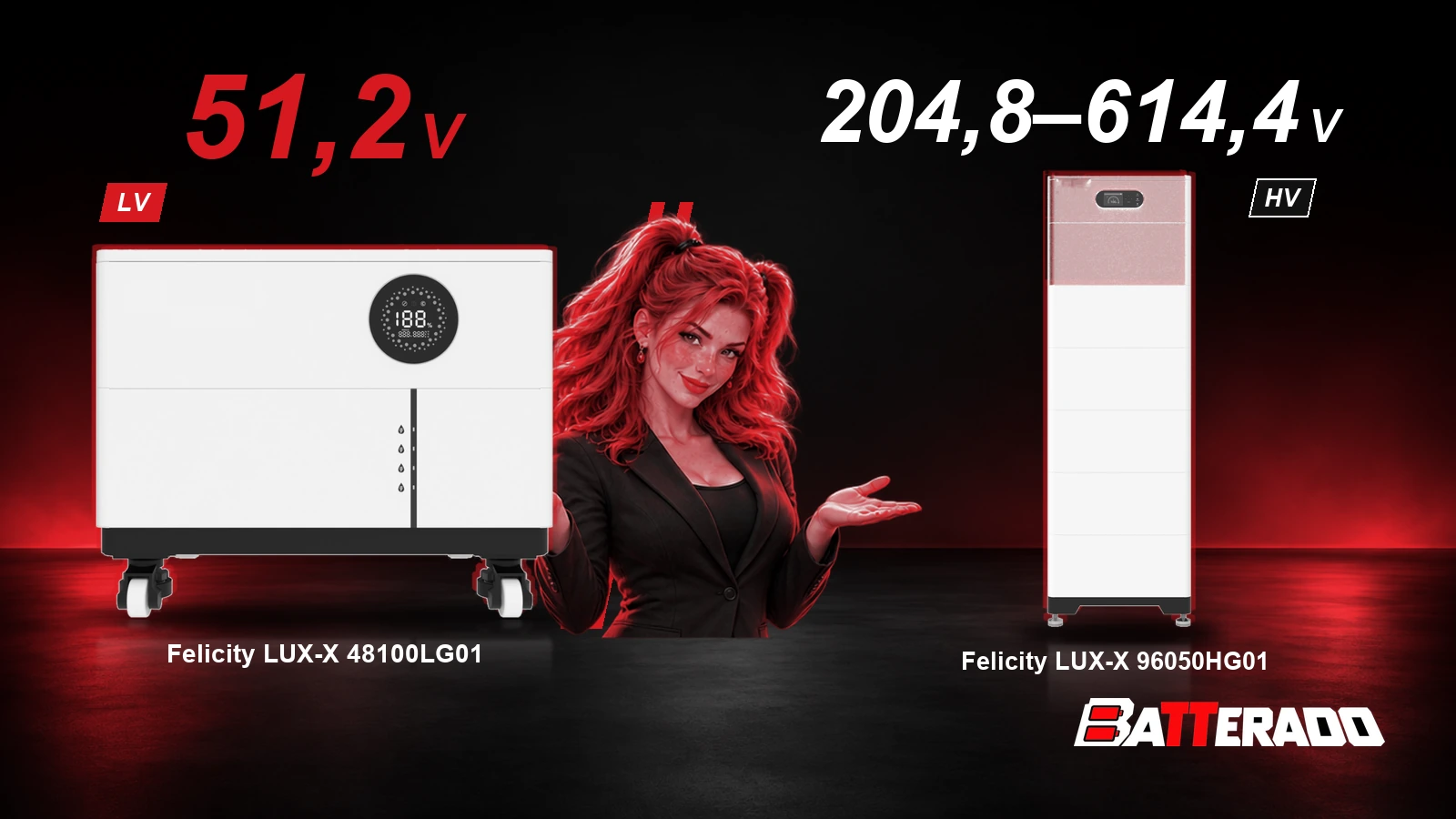
Low-voltage (LV, 51.2 V) and high-voltage (HV, several hundred volts) batteries use the same LiFePO4 cells. They differ in how cells and modules are connected, and that decides the current at a given power, the cabling, the matching inverter and the way the system grows. The right choice is the one where battery and inverter share the same voltage and the same communication language.

How LV and HV systems differ
A LiFePO4 cell is rated 3.2 V. Sixteen cells in series give 51.2 V, the voltage that matches 48 V inverters. In LV batteries modules are added in parallel: the voltage stays at 51.2 V while capacity and available current grow. The Felicity LUX-X-48100LG01 kit with two modules offers 10.24 kWh, and the four-module kit (20.48 kWh) still runs at 51.2 V, now with up to 240 A continuous current.
In HV batteries modules are connected in series and their voltages add up. A Felicity LUX-X HV module is rated 102.4 V / 50 Ah (32 cells in series, 1P32S layout), which is 5.12 kWh. Two modules give 204.8 V (10.24 kWh), four modules 409.6 V (20.48 kWh). Capacity grows with voltage while the current stays in the range of tens of amperes.
| Parameter | Low-voltage battery (LV) | High-voltage battery (HV) |
|---|---|---|
| Nominal voltage | 51.2 V | 204.8 V to 409.6 V (LUX-X, depending on module count) |
| Module connection | parallel, voltage unchanged | series, voltages add up |
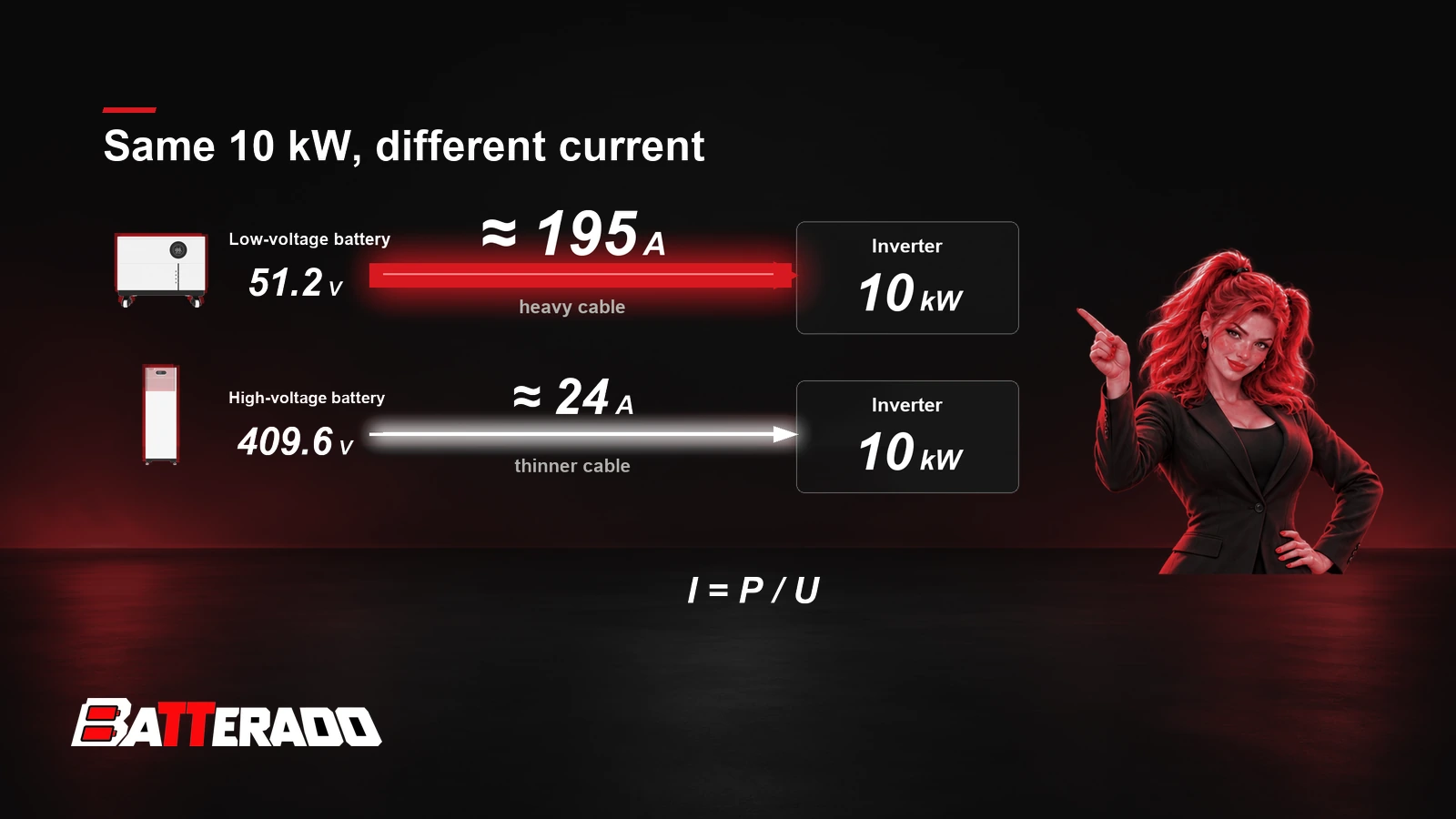
| Current at 10 kW | about 195 A | about 24 A at 409.6 V |
| Cabling | thick conductors, short run between battery and inverter | thinner conductors, low losses over longer runs |
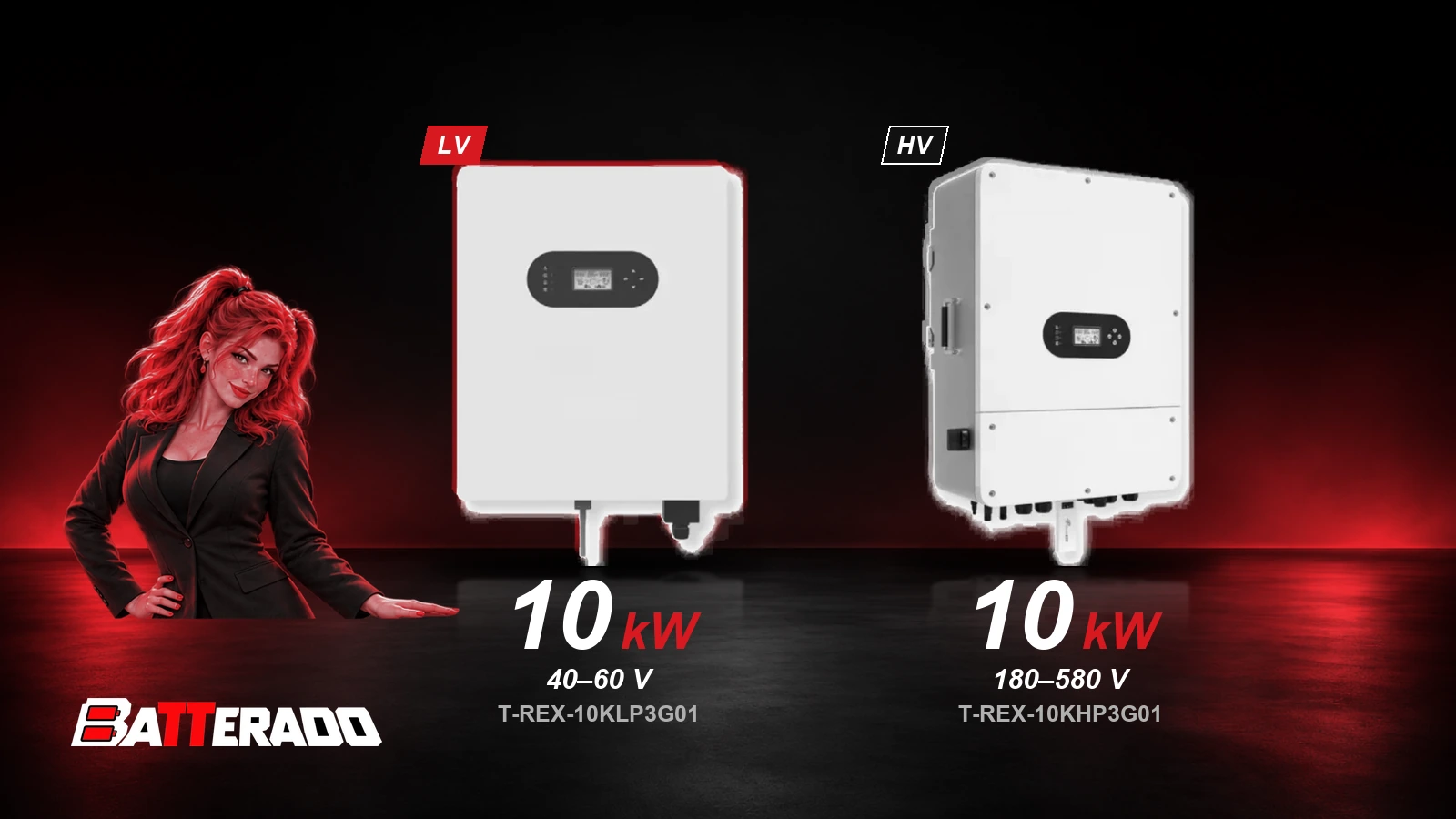
| Inverter battery input | 40–60 V | 180–580 V (e.g. T-REX-10KHP3G01) |
| Typical use | single-phase house, 3–10 kW inverters, simple parallel expansion | three-phase house, higher power, more capacity in one column |
Currents and cables at the same power
Power is voltage times current. At 10 kW a 51.2 V battery delivers about 195 A (10,000 / 51.2), a 409.6 V battery only about 24 A (10,000 / 409.6). Eight times less current means thinner conductors, lower heat losses and a good fit for longer cable runs. The higher current of an LV system belongs to a very simple, proven design: the battery stands right next to the inverter, the short heavy connection is quick to make, and modules are added in parallel without changing the voltage.
What has to match the inverter
- Voltage range. The battery voltage sits inside the inverter’s battery input. A 48 V inverter with a 40–60 V range pairs with a 51.2 V battery; an HV inverter with a 180–580 V input pairs with a 204.8 V or 409.6 V kit.
- BMS communication. Inverter and battery exchange state of charge, current limits and temperatures over CAN or RS485, typically via an RJ45 cable. The inverter then charges exactly as the BMS asks.
- Protocol or profile. The battery’s product page states which profile the inverter uses. For example the Deye SE-F16-C works with the Deye CAN protocol, set in the inverter as Lithium Mode 00; BYD batteries use the BYD profile from the manufacturer’s official list.
- Charge and discharge current. The inverter current matches the current the battery handles continuously. The T-REX-10KLP3G01 works with up to 200 A, the LUX-X 20.48 kWh LV kit has 240 A continuous. In the HV pair, the T-REX-10KHP3G01 (25 A) and LUX-X HV (up to 50 A continuous) have current to spare.
When each system fits
LV is the natural choice for a single-phase house and inverters up to roughly 10 kW. Inverters such as the Deye SUN-8K-SG05LP1-EU-AM2-P (8 kW, battery 40–60 V, current up to 190 A) have a battery input made for 51.2 V. Expansion is straightforward: another module goes in parallel, with the Deye SE-F16-C up to 32 units.
HV shines in three-phase houses, with larger inverters and larger capacity: high voltage carries the same power at a small current, and a single tower holds a lot of kilowatt-hours. The BYD Battery-Box HVM+ 22.1 offers 22.08 kWh at 409.6 V and can be built up to 66.2 kWh (3 systems).
Pairs from our range
- Felicity LUX-X: LV 10.24 kWh and LV 20.48 kWh (51.2 V, CAN / RS485, IP21) versus HV 10.24 kWh and HV 20.48 kWh (204.8 V and 409.6 V, CAN / RS485, IP65).
- Felicity 10 kW three-phase inverters: T-REX-10KLP3G01 for a 40–60 V battery (current 200 A) and T-REX-10KHP3G01 for a 180–580 V battery (current 25 A). Both versions communicate with the battery over CAN or RS485.
- Deye: the SE-F16-C battery (16 kWh, 51.2 V / 314 Ah, CAN 2.0 / RS485, Lithium Mode 00) with the SUN-8K-SG05LP1-EU-AM2-P (single-phase, 8 kW) or the three-phase SUN-10K-SG05LP3-EU-SM2 (10 kW, battery 40–60 V, current up to 210 A, CAN or RS485). The official Deye list quoted on the battery page confirms the exact inverter series.
- BYD: Battery-Box Premium LVS 16.0 (16 kWh, 51.2 V, 40–57.6 V, 250 A continuous, CAN, IP55) and Battery-Box HVM+ 22.1 (22.08 kWh, 409.6 V, 320–460.8 V, 50 A continuous, CAN / RS485, IP55).
Pairing checklist
- The battery voltage sits within the inverter’s battery input range.
- Inverter and battery share an interface (CAN or RS485) and the profile stated on the product page.
- The inverter current matches the battery’s continuous current.
- The capacity covers the evening and night consumption of the house.
- Battery class (LV or HV) is the same for battery and inverter.
- The expansion plan (parallel or additional series modules) follows the manufacturer’s data.
In short
LV is a simple, flexible choice for a single-phase house and 48 V inverters, while HV offers small currents and high capacity for three-phase systems. Our guide Tomo will help you choose directly on the website, or send us a question using the “Ask a question” button on the product page.