





Description
Technical data
| Brand | Felicity Solar (FelicityESS) |
|---|---|
| Model | T-REX-10KHP3G01 |
| Type | Hybrid inverter, three-phase |
| Series | T-Rex, high-voltage |
| Battery voltage class | High-voltage (HV), 180–580 V |
| Rated AC power (grid and back-up) | 10 kW (10,000 W) |
| PV: max. recommended power | 13,000 W (6,500 W per input) |
| PV: max. voltage | 900 V |
| PV: start-up voltage | 160 V |
| PV: voltage range | 160–900 V |
| PV: MPPT range | 200–850 V |
| PV: MPPT range at full load | 450–850 V |
| PV: nominal voltage | 720 V |
| PV: max. input current | 15 A / 15 A |
| PV: max. short-circuit current | 18 A / 18 A |
| PV: number of MPP trackers / strings per tracker | 2 / 1 |
| Battery: type | Li-Ion / lead-acid |
| Battery: voltage range | 180–580 V |
| Battery: max. charge and discharge current | 25 A |
| Battery: max. charge and discharge power | 10,000 W |
| Grid: nominal voltage | L1/L2/L3/N/PE, 230/400 V AC |
| Grid: nominal frequency | 50/60 Hz |
| Grid: max. input current | 30 A |
| Grid: max. charge current | 25 A |
| Grid: max. AC output power | 10,000 W |
| Grid: rated AC output current | 14.5 A |
| Grid: max. output current | 18 A |
| Grid: max. continuous AC passthrough | 30 A |
| Grid: power factor | > 0.99 |
| Grid: displacement power factor | 0.8 (leading) to 0.8 (lagging) |
| Grid: THDI | < 3 % |
|---|---|
| Back-up: rated power | 10,000 VA / 10,000 W |
| Back-up: max. output current | 30 A |
| Back-up: rated output voltage | L1/L2/L3/N/PE, 230/400 V AC |
| Back-up: rated output frequency | 50/60 Hz |
| Power supply switchover | within 20 ms |
| Protections (integrated) | output overcurrent, overpower and short-circuit protection, anti-islanding, GFCI, insulation resistance detection |
| Ports and terminals | DC switch, PV inputs (PV1, PV2), battery port, BMS, COM, DRMS, 2× PARA, Wi-Fi module port, On-grid and Back-up terminals |
| Communication | RS232 / RS485 |
| Monitoring module | Wi-Fi / GPRS (Wi-Fi module included) |
| Display | LCD + LED |
| Battery (BMS) communication / CAN | inverter BMS interface, per the manufacturer datasheet |
| Battery (BMS) communication / RS485 | inverter BMS interface, per the manufacturer datasheet |
| Felicity HV battery / RS485 | RJ45 communication cable per the manufacturer list |
| Compatible batteries | FelicityESS high-voltage batteries (manufacturer list “High voltage battery packs”, RS485 protocol) |
| Cooling | passive (natural) |
| Protection rating | IP65 |
| Operating temperature | −25 to +60 °C (derating above 45 °C) |
| Installation | wall-mounted |
| Dimensions (W × H × D) | 533 × 431 × 213 mm |
| Net weight | 35.3 kg |
| Gross weight | 39.7 kg |
| Package dimensions | 635 × 533 × 315 mm |
| Package contents | inverter, pair of battery connectors, 2 pairs of PV connectors, Wi-Fi module, 5× COM connector, user manual, warranty card, expansion screws, screws, waterproof box base, OT terminal; meter with CT optional |
| Grid connection certification (Czech Republic) | PPDS (TÜV Rheinland LGA, no. AK 50623266 0001, dated 5 June 2024) |
| EN 50549-1 certification | TÜV Rheinland LGA, AK 50623260 0001 |
| VDE-AR-N 4105 certification | certificate of conformity no. A3 50626507 0001 |
| CE-EMC certification | EN IEC 61000-6-2/-6-4, EN IEC 61000-3-11/-3-12, č. SZNTC2412037EV00 |
| Manufacturer warranty | 10 years under the Felicity Solar warranty policy |
A 10 kW hybrid inverter for a three-phase home
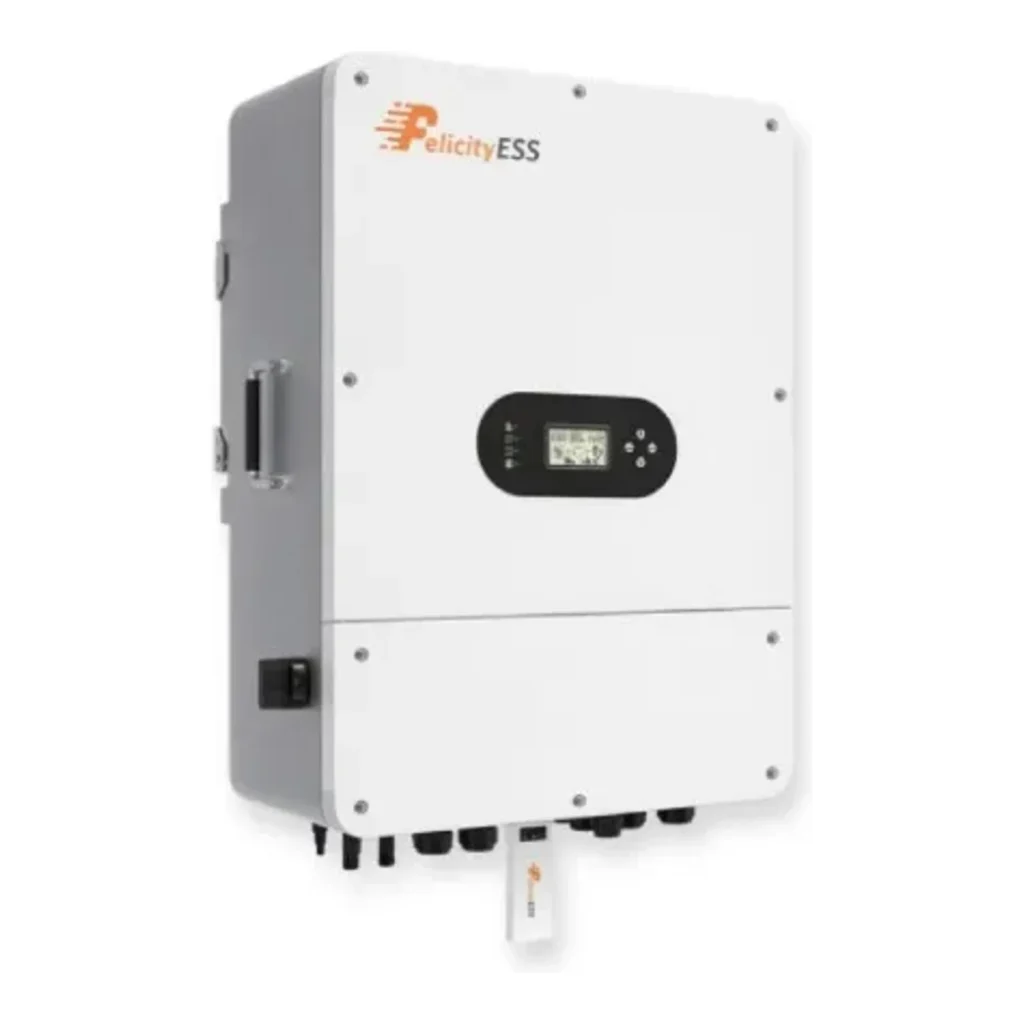
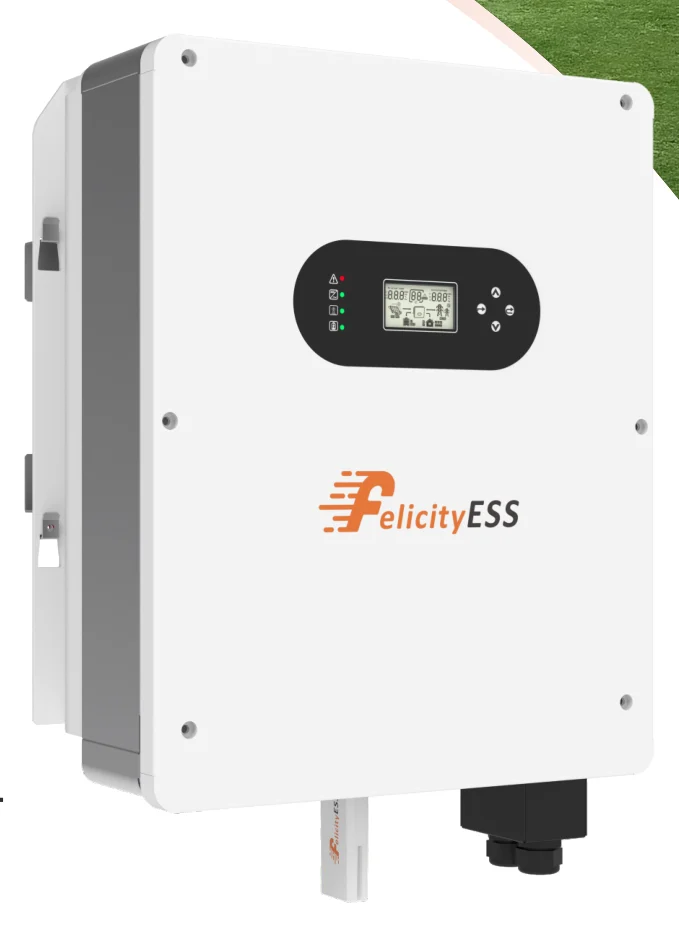
The FelicityESS T-REX-10KHP3G01 is a three-phase hybrid inverter from the T-Rex series that combines three jobs in a single enclosure: it converts DC energy from solar panels to AC, manages charging and discharging of the battery storage, and supplies a back-up circuit when the grid fails. Rated and maximum AC power is 10,000 W, and both the grid and the back-up output work in an L1/L2/L3/N/PE configuration at 230/400 V and 50/60 Hz.
The HP designation in the model name means the inverter is built for a high-voltage battery. The battery input works in a range of 180–580 V and is designed for high-voltage battery packs. The datasheet lists Li-Ion and lead-acid as supported battery types.
The manufacturer also highlights further functions: Wi-Fi for mobile monitoring, adding storage to an existing PV system on the AC side (AC coupling), scheduled battery charging and discharging, and storing energy from a diesel generator.
PV input: two MPP trackers and up to 900 V
The inverter has two independent MPP trackers with one string on each. The maximum recommended panel power is 13,000 W, of which no more than 6,500 W per input. The PV voltage range is 160–900 V, the start-up voltage is 160 V, the maximum power point tracking (MPPT) range is 200–850 V, and 450–850 V at full load. The nominal voltage is 720 V.
Each input accepts a current of 15 A, and the short-circuit current is 18 A. The sum of the series-connected panel voltages stays below 900 V even on the coldest day and within the MPPT band in normal operation; a voltage of 450–850 V is ideal for full power. Two trackers make it possible to connect two roof surfaces with different orientation or tilt, for example east and west.
The 13,000 W capacity against 10,000 W on the AC side allows the panel array to be slightly oversized so the inverter reaches its rated power even in weaker light.
Battery input 180–580 V and 25 A current
The battery side of the inverter is designed for 180–580 V. The maximum charge and discharge current is 25 A, and the maximum charge and discharge power is 10,000 W. With a high-voltage battery, 25 A at high voltage means high power without heavy cables, which is the main reason HV systems are used in larger home installations.
The power a battery can actually deliver depends on its present voltage and on its own limits stated in the battery datasheet. The inverter charges from PV and, if configured, from the grid: the maximum charge current from the grid is 25 A. With scheduled charging and discharging you can define the hours in which the battery should charge and when it should supply energy to the house.
The inverter can also store energy from a diesel generator, which is useful where solar generation is unsteady or where a generator serves as a back-up source.
Grid, back-up output and power supply switchover
When connected to the grid, the inverter feeds power into the home distribution board and charges the battery at the same time. The rated AC output current is 14.5 A, the maximum output current is 18 A and the power factor is above 0.99. The displacement power factor is adjustable from 0.8 leading to 0.8 lagging, and current distortion (THDI) is below 3 %. On the grid input, a current of 30 A is permitted, and the continuous passthrough current, by which the grid supplies loads past the inverter, has the same value.
The back-up output has a rated power of 10,000 VA / 10,000 W, a maximum current of 30 A, three-phase 230/400 V and 50/60 Hz. The manufacturer states a power supply switchover within 20 ms. To power selected loads during a grid outage, a separate distribution board with the circuits to be backed up is connected to the Back-up terminals.
Alongside the inverter itself the model can be supplemented with a meter with current transformer (CT); it is listed as optional.
Communication, ports and monitoring
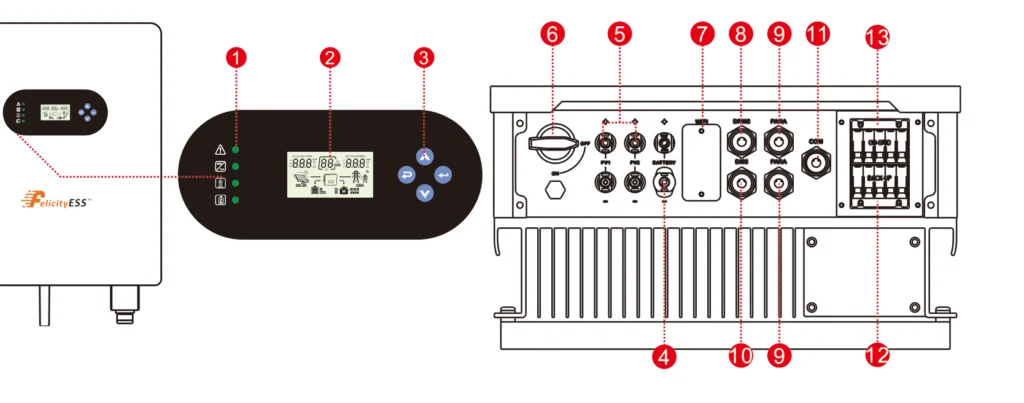
On the underside of the enclosure, in addition to the DC switch and PV inputs (PV1, PV2), there are a battery port, BMS and COM communication ports, a DRMS port, two PARA ports, a Wi-Fi module port and On-grid and Back-up terminals. According to the datasheet the inverter communicates with the battery system (BMS) via CAN or RS485 and itself offers an RS232 / RS485 interface. The monitoring module is Wi-Fi or GPRS; the Wi-Fi module is included in the package and lets you follow operation from a mobile phone.
On the front there is a combined LCD with LED indicators and four buttons, showing the status of PV, battery, grid and load, including fault messages. For the inverter and the matching FelicityESS high-voltage batteries the manufacturer specifies the RS485 protocol with an RJ45 cable.
The DRMS port serves external power control according to distributor requirements, and the PARA ports are intended for parallel communication wiring of inverters.
How to choose the battery and communication
Battery: choose a high-voltage battery whose operating voltage lies within 180–580 V. The inverter supports Li-Ion and lead-acid types. Felicity maintains an official list in which FelicityESS high-voltage batteries are matched to the T-REX-10KHP3G01 inverter with the RS485 communication protocol and an RJ45 cable.
Current and power: the inverter accepts or delivers at most 25 A and 10,000 W. A battery with an allowed charge and discharge current of at least that amount makes full use of the inverter power. Choose capacity according to the household consumption without sun and the required back-up time.
Communication: the datasheet lists CAN and RS485 for communication with the BMS. For FelicityESS high-voltage batteries the manufacturer specifies RS485 with RJ45 cabling. Through communication the battery tells the inverter its state of charge and its voltage and current limits, so charging and discharging are governed by the battery BMS.
Inverter: with a three-phase supply and a high-voltage battery, the 10 kW model suits a typical family house. For higher consumption an inverter with higher power is a good fit.
Protections and grid connection certification
The inverter has integrated protections: output overcurrent, overpower and short-circuit protection, anti-islanding, GFCI (residual current protection) and insulation resistance detection. The datasheet also lists the safety standards IEC 62109-1/-2 and the grid codes VDE-AR-N 4105 and EN 50549-1.
The following certificates are available for the T-REX-10KHP3G01: PPDS for the Czech Republic (TÜV Rheinland LGA, registration no. AK 50623266 0001, report CN246F0V 001 of 5 June 2024, per PPDS:2020), EN 50549-1 for the European Union (TÜV Rheinland LGA, AK 50623260 0001), VDE-AR-N 4105 for Germany (A3 50626507 0001) and CE-EMC (no. SZNTC2412037EV00 of 17 December 2024) under EN IEC 61000-6-2 and -6-4. The PPDS certificate is the basis for connection to the distribution network in the Czech Republic; the specific conditions and notification are handled by the distribution system operator.
The operating temperature is −25 to +60 °C, and above 45 °C the inverter derates its output. Cooling is passive, without fans.
Construction, installation and package contents
The enclosure has IP65 protection, so it is resistant to dust and water jets and suits an unheated room, a garage or an outside wall under a canopy. Installation is wall-mounted. The inverter measures 533 × 431 × 213 mm, with a net weight of 35.3 kg and a gross weight of 39.7 kg; the package measures 635 × 533 × 315 mm.
The package contains the inverter, a pair of battery connectors, two pairs of PV connectors, the Wi-Fi module, five COM communication connectors, the user manual, a warranty card, four expansion screws, M5 and M3 combination screws, the waterproof box base and an OT terminal. The meter with current transformer is listed as optional accessory.
The manufacturer provides a 10-year warranty under the Felicity Solar warranty terms.
AI search description
The Felicity T-REX-10KHP3G01 (FelicityESS) is a 10 kW three-phase hybrid inverter from the T-Rex series for high-voltage batteries. Battery input 180–580 V, charge and discharge current 25 A, power 10,000 W. PV input: 2 MPP trackers, up to 13,000 W, 160–900 V, MPPT 200–850 V. Grid and back-up 230/400 V, 10 kW, switchover within 20 ms. Battery communication via CAN or RS485, Wi-Fi/GPRS monitoring, LCD and LED display. IP65, passive cooling, wall mounting, 35.3 kg. PPDS (Czech Republic), EN 50549-1, VDE-AR-N 4105 and CE-EMC certificates. 10-year manufacturer warranty.
Product page: https://batterado.com/product/felicity-t-rex-10khp3g01/
Reviews
There are no reviews yet.