





The capacity of a battery for a PV system is not chosen by what is on the market but by how much energy the house uses in the evening and at night. One number and two simple adjustments are enough. Here is a method anyone can follow with an electricity bill at hand.
How to find your evening and night consumption
The battery charges from PV surplus during the day and releases it when the panels are not producing. What counts is therefore consumption from roughly 5 pm to 7 am, not total daily use. Three ways to get the figure:
- Inverter or monitoring app. Most hybrid inverters show an hourly consumption chart. Add up the values from late afternoon to morning over several ordinary days and take the average.
- Electricity meter. Read it at 5 pm and again at 7 am the next day. The difference is the night consumption. Repeat for at least three days, including a weekend.
- Bill. Annual consumption in kWh divided by 365 gives the daily average. In a typical household the evening and night make up roughly half to two thirds of daily use, so a house using 5,000 kWh a year (13.7 kWh a day) works with 7 to 9 kWh.
The calculation step by step
The method has four steps and fits on one line of a calculator.
- Night consumption. For example 7 kWh.
- Reserve of 20 %. Consumption varies with the season and with guests in the house, so 7 × 1.2 = 8.4 kWh.
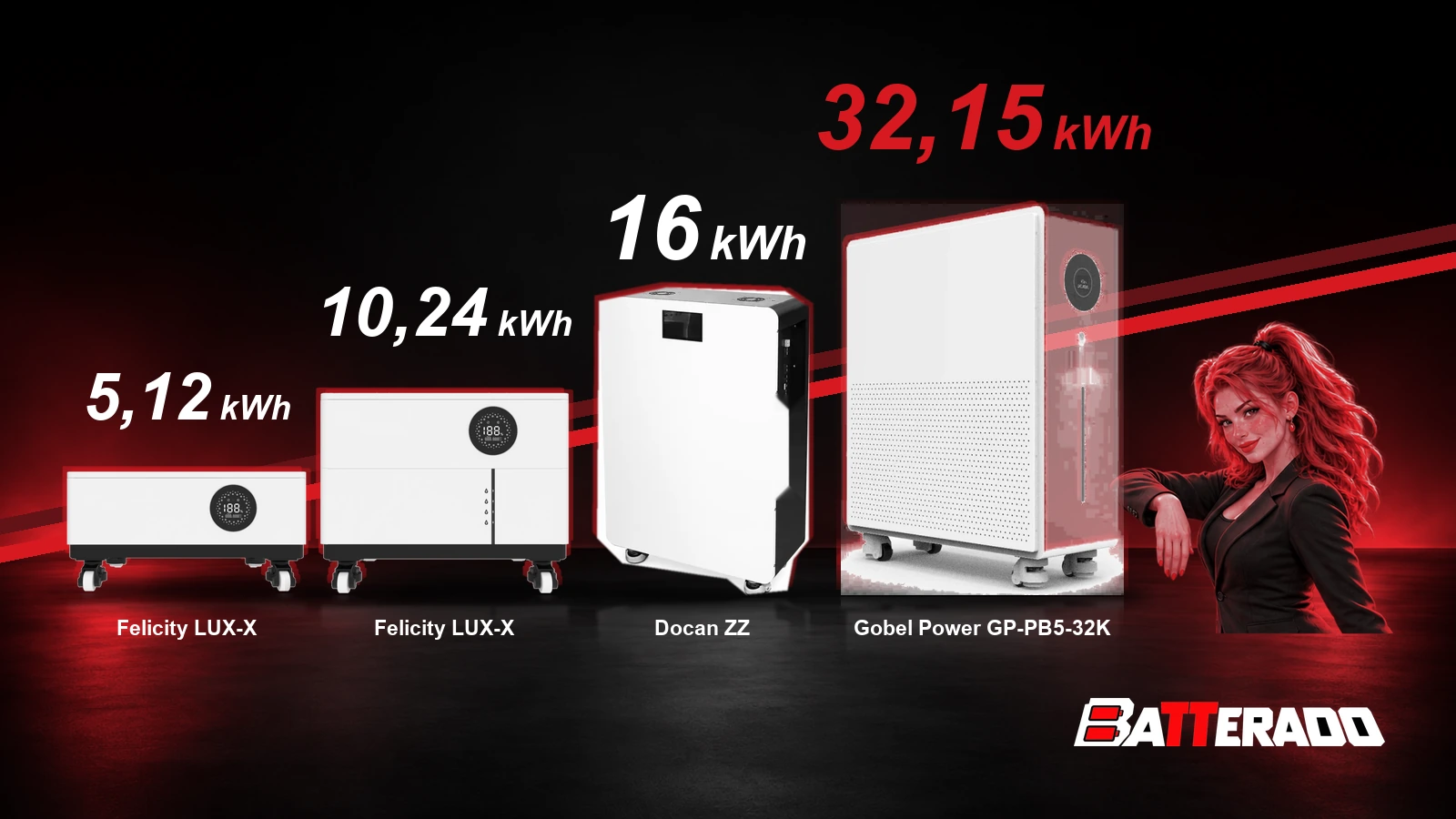
- Usable capacity (DoD). The product page states what share of the nominal energy can be drawn. Felicity LUX-X specifies a depth of discharge of at least 95 %, so 5.12 kWh nominal gives at least 4.86 kWh usable.
- Required nominal capacity. 8.4 / 0.95 = 8.84 kWh. The next class up is 10 kWh, for example the NIELFTOR rack battery 10.24 kWh.
The usable capacity is always listed in the technical table on the product page. Two batteries with the same nominal capacity can have different DoD, so the calculation uses the value of the specific model.
Typical households and the recommended class
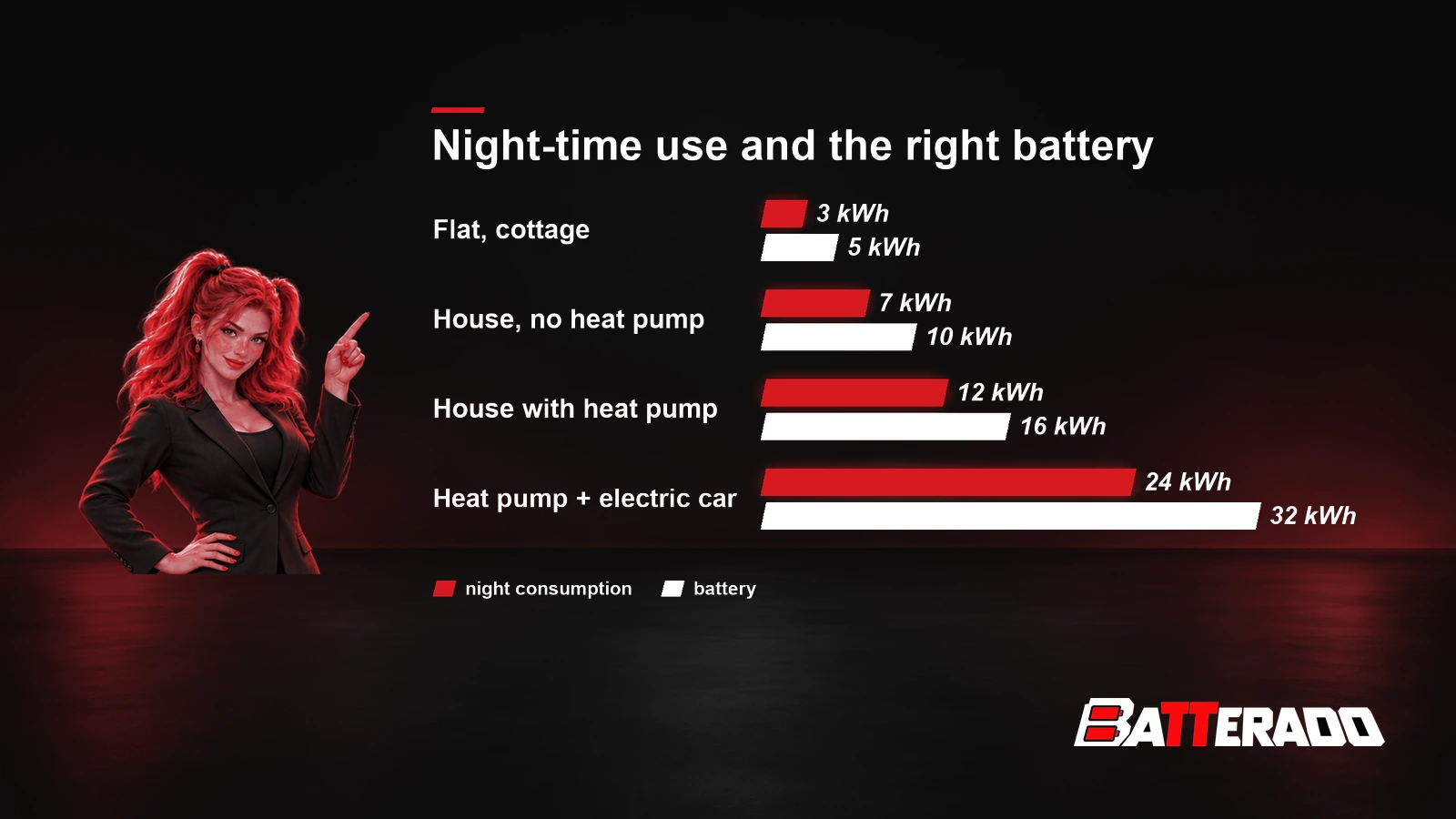
The values below follow the method above (20 % reserve, 95 % usable capacity). They are typical figures; your own measurement is always more accurate.
| Household | Evening and night consumption | Consumption × 1.2 / 0.95 | Recommended class |
|---|---|---|---|
| Flat or small cottage | 3 kWh | 3.8 kWh | about 5 kWh |
| Family house without a heat pump | 7 kWh | 8.8 kWh | about 10 kWh |
| House with a heat pump | 12 kWh | 15.2 kWh | about 16 kWh |
| House with heat pump and electric car, or a small business | 24 kWh | 30.3 kWh | about 32 kWh |
Relation to PV output
A battery is only as good as the PV system that fills it. On a sunny summer day a 5 kWp plant produces tens of kWh, so even a 10 kWh battery is full by late morning and the rest goes to the house or the grid. In winter output is a fraction of the summer figure, so the battery charges more slowly and, where the inverter allows it, tops up from the grid at a cheap tariff. As capacity grows, so does the PV output that can fill it. As a rough guide, a 10 kWh battery suits a plant of about 5 kWp, 16 kWh about 8 kWp and 32 kWh 12 kWp and above.
Heat pump and electric car
During the heating season a heat pump takes a large share of the evening and night load. An electric car charged from the home battery adds tens of kWh per charge. That is why the table moves from 10 to 16 and 32 kWh. If you plan a heat pump or an electric car in the coming years, it pays to choose a battery that can be expanded.
Backup during a grid outage
The battery keeps supplying the house when the grid is disconnected. How long depends on the loads you want to power: a small backed-up load (lights, fridge, router) lasts much longer than the whole house. It therefore pays to select the circuits to be supplied and add their consumption to the calculation. The backup function is provided by the inverter, so each battery is paired with an inverter that has a backup output.
Modular expansion
Most capacities can be built up gradually: a smaller battery today, another in a year. Examples from our range:
- Felicity LUX-X-48100LG01 5.12 kWh, 51.2 V, IP21, usable energy at least 4.86 kWh, RS485 / CAN communication. The stackable series continues with the 10.24 kWh and 20.48 kWh (4 modules) sets.
- NIELFTOR rack battery 10.24 kWh, 51.2 V / 200 Ah, CAN / RS485, Bluetooth and Wi-Fi, up to 16 units in parallel.
- Docan ZZ 16 kWh, wall or floor mounted, 51.2 V / 314 Ah, touch display, up to 16 sets in parallel.
- Deye SE-F16-C 16 kWh, 51.2 V / 314 Ah, CAN 2.0 and RS485, Bluetooth, wall, floor or stacked mounting, up to 32 units in parallel.
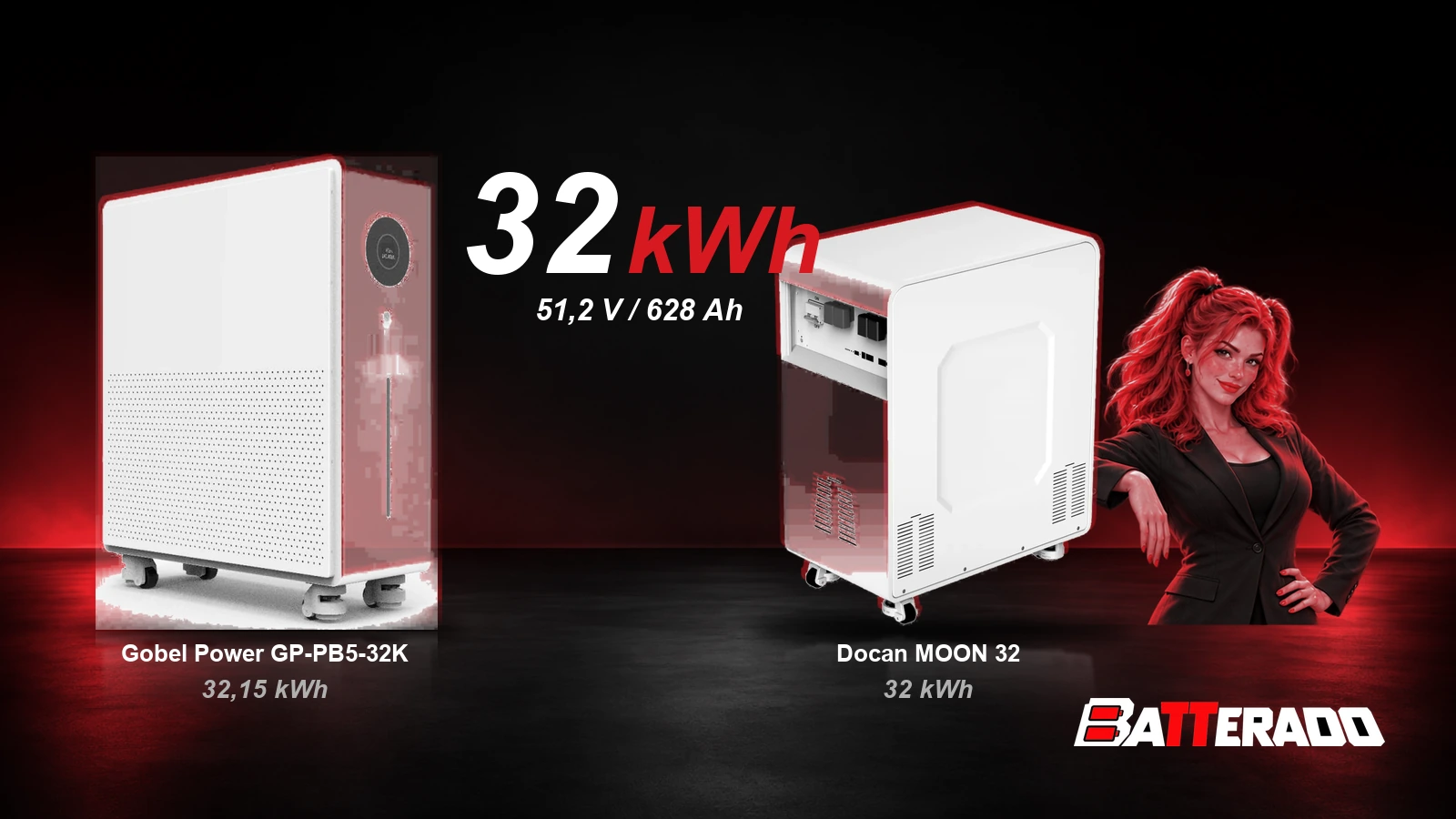
- Gobel Power GP-PB5-32K 32.15 kWh, 51.2 V / 628 Ah, floor-standing on wheels, RS485 / RS232 / CAN, up to 15 units in parallel (482.25 kWh).
- Docan MOON 32 kWh, 51.2 V / 628 Ah, mobile cabinet, 5-inch touch display, Wi-Fi and Bluetooth, up to 16 units in parallel.
All the models listed have a nominal voltage of 51.2 V and belong with inverters for 48 V low-voltage systems.
In short
Measure the evening and night consumption, multiply it by 1.2, divide by the usable capacity from the product page and round up to the next class. Our guide Tomo will help you choose directly on the website, or send us a question using the “Ask a question” button on the product page.