





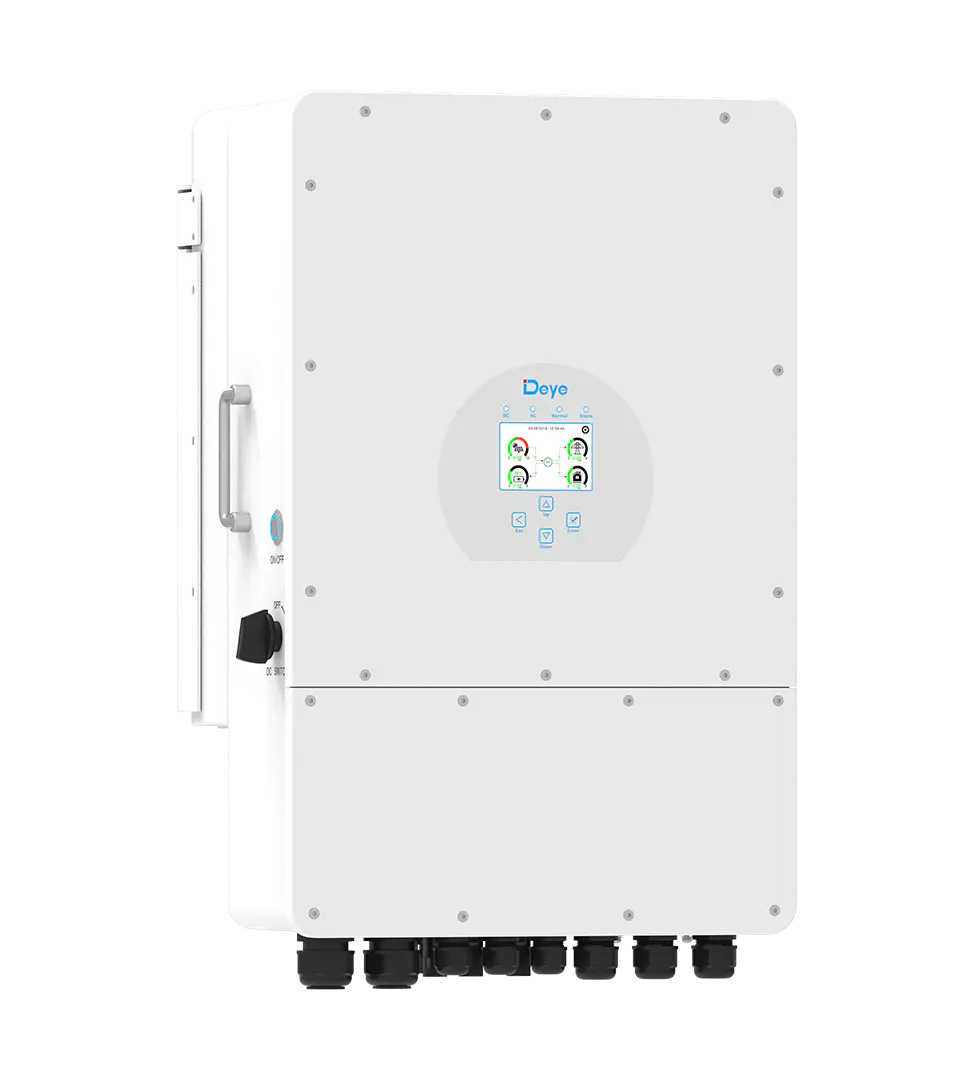
Description
Technical specifications
| Model / role | Deye SUN-10K-SG04LP3-EU; standalone three-phase hybrid inverter |
|---|---|
| Inverter rated AC and UPS power | 10000 W |
| Inverter maximum AC power | 11000 W |
| Inverter off-grid peak power | 2× rated power, 10 s |
| Phases / rated AC voltage | Three phase; 220/380 or 230/400 V; 3L+N+PE |
| Output frequency | 50/60 Hz; range 45–55 / 55–65 Hz |
| Rated AC output current | 15.2/14.5 A |
| Maximum AC current | 16.7/15.9 A |
| Maximum continuous AC passthrough | 45 A |
| Power factor range | 0.8 leading to 0.8 lagging |
| THD / DC current injection | <3 % at nominal power; <0.5 % In |
| Inverter battery voltage range | 40–60 V |
| Inverter max. charge / discharge current | 210 / 210 A |
| Charging curve / lithium charging control | 3 stages / equalisation; self-adaptation to BMS for lithium |
| Inverter external temperature sensor | Supported |
| Maximum PV DC input power | 13000 W |
| Rated / operating PV voltage | 550 V; 160–800 V |
| MPPT tracking range | 200–650 V |
| Full-load DC voltage range | 350–650 V |
| PV start-up voltage | 160 V |
| PV input current | 26 + 13 A |
| MPPT trackers / strings per tracker | 2 / 2 + 1 |
| Maximum / European / MPPT efficiency | 97.60 % / 97.00 % / 99.90 % |
| Inverter BMS ports | Combined CAN / RS485 RJ45 |
| Inverter BMS CAN RJ45 pinout | 4: CAN-H; 5: CAN-L |
| Inverter BMS RS485 RJ45 pinout | 1/8: RS485B; 2/7: RS485A; 6: GND_485 |
| Inverter meter RS485 pinout | 1/8: METER-485-B; 2/7: METER-485-A; 3/6: COM-GND |
| Data logger port | RS232/Wi-Fi (DB9); 2: TX; 3: RX; 5: D-GND; 9: +12 V DC |
| CT accessory in manual appendix | Split-core current transformer; 4 m secondary cable |
| Inverter modes | Grid-connected, off-grid, backup, peak shaving; installation-specific |
| Integrated inverter protections | Anti-islanding, PV reverse polarity, insulation and residual-current monitoring, output overcurrent and short circuit, PV lightning protection |
| Inverter operating temperature | −40 to +60 °C; derating above 45 °C |
| Inverter cooling / noise | Smart cooling; ≤45 dB(A) |
| Inverter protection / mounting | IP65; wall-mounted |
| Inverter W × H × D | 422 × 702 × 281 mm; excluding connectors and brackets |
| Inverter weight in manual | 33.6 kg |
| Grid standards in manual | VDE4105; IEC61727/62116; VDE0126; AS4777.2; CEI0-21; EN50549-1; G98; G99; C10-11; UNE217002; NBR16149/NBR16150 |
| Safety / EMC in manual | IEC/EN62109-1; IEC/EN62109-2; IEC/EN61000-6-1/-6-2/-6-3/-6-4 |
| Battery types | Lead-acid or Li-ion; control according to selected BMS profile |
|---|---|
| Parallel system | Supports parallel operation of multiple units |
| User interface | Colour LCD, function buttons and status indicators |
| Time control and priorities | 6 time periods; PV/grid/generator and battery/grid priorities |
| Smart Load / export limitation | Smart Load; Zero Export to CT or meter; peak shaving |
| Meters shown in manual | CHNT/CHINT DTSU666; Eastron SDM630-Modbus V2 |
| Parallel communication ports | Parallel A and Parallel B — CAN |
| Generator control | CN2 G-start (1,2): dry-contact start signal; Gen terminals |
| Wi-Fi monitoring | Optional Wi-Fi plug via RS232 |
| Recommended battery cable | 50 mm² / 1/0 AWG |
| Battery terminals / max. torque | M10; 24.5 N·m |
| Recommended AC cable / max. torque | Grid: 6 mm²; backup: 4 mm²; both manual tables labelled 10 AWG; 1.2 N·m |
| Recommended PV cable | 4 mm² / 12 AWG |
| AC breakers recommended in manual | 63 A grid branch; 32 A backup branch |
| Connection and protection | Grid / Load / Gen; PE; separate DC overcurrent protection and battery/PV isolation |
| Mounting clearances | ≈500 mm sides/above/below; ≈1000 mm front |
| Mounting holes | 4 holes, 82–90 mm depth |
| Bracket — drawing dimensions | 422 × 363 mm; lower dimension 410 mm |
| Height in detailed drawing | 702 mm; additional width dimensions 450.9 / 460.9 mm |
| Installation altitude | Approximately up to 2000 m per installation conditions |
| Installation humidity | Up to 95 % per installation conditions |
| Appendix CT — model and ratio | CTSA016; 100 A / 50 mA = 2000:1 |
| CT — drawing aperture | Ø16.1 ±1.0 mm |
| CT — appendix dimensions | 41.8 ±1.5; 37.8 ±1.5; 48.9 ±1.5; 30.26 ±1.0; 28.6 ±1.0; 20.9 ±1.0 mm |
| Warranty per applicable manual | 5 years |
| Equipment listed in manual | Inverter, bracket, parallel cable, hex key, 4× M8×80, manual, battery-temperature sensor, 3 CTs |
| Unbalanced output | 100 % unbalanced output; each phase up to 50 % rated power |
| Max. unbalanced output current | 22.7/21.7 A |
| Max. output short-circuit current | 70 A |
| AC voltage range | 0.85–1.1 Un |
| Max. PV short-circuit current | 34 + 17 A |
| CN1 — temperature and CTs | TEMP: 1/2; CT-L1: 3/4; CT-L2: 5/6; CT-L3: 7/8 |
| CN2 — further function terminals | G-valve: 3/4; Grid_Ry: 5/6; RSD: 7+/8−, 12 V DC with battery connected and inverter on |
| Port labelled Modbus — appendix pinout | 1/8: RS485B; 2/7: RS485A; 3/6: GND_485; hardware-dependent |
| Shipping weight in offer | 35 kg |
| Overvoltage category | DC II / AC III |
| Battery-side isolation | Transformer isolation according to datasheet |
| Grid standards in datasheet | IEC 61727; IEC 62116; CEI 0-21; EN 50549; NRS 097; RD 140; UNE 217002; OVE-Richtlinie R25; G99; VDE-AR-N 4105 |
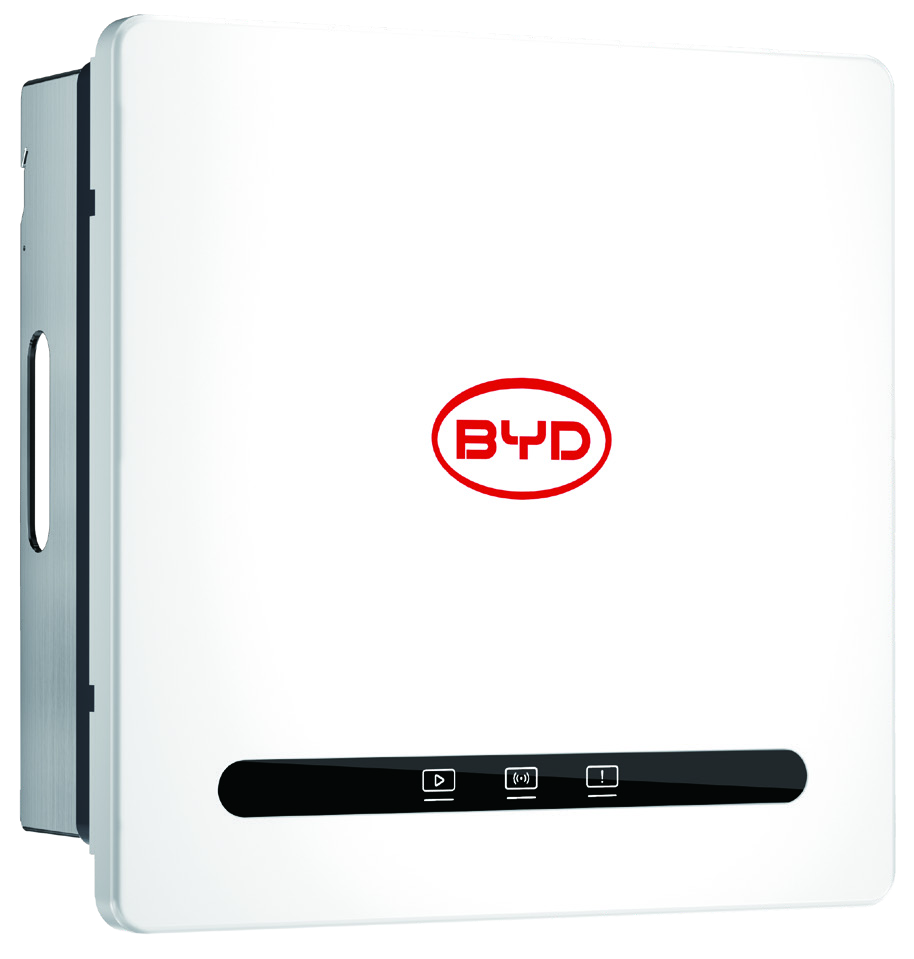
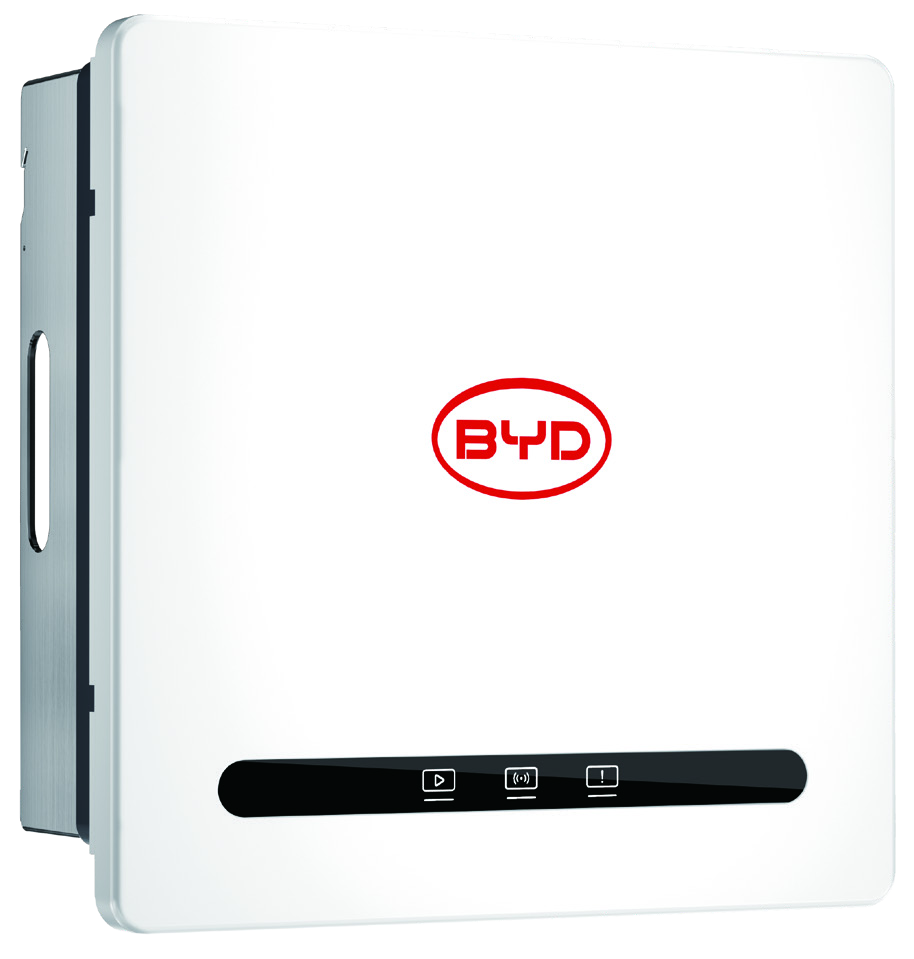
10 kW for a three-phase energy system
SUN-10K-SG04LP3-EU provides 10000 W rated AC and UPS output and 11000 W maximum AC output. Connection is three-phase 220/380 or 230/400 V, 3L+N+PE. Solar generation can serve self-consumption, battery charging and grid export according to configured settings. Off-grid surge power is twice rated output for ten seconds. System planning therefore distinguishes simultaneous appliance demand from short starting surges and required operating duration.
Unbalanced output for individual phase demand
The inverter supports 100% unbalanced output. The datasheet allows each phase up to 50% of rated power, equivalent to 5 kW for this 10 kW model within the total operating limits. This helps match generation and storage to ordinary single-phase appliances across the property. The specification separately lists rated, maximum and unbalanced output currents. Backup circuits are selected by power and purpose, such as household operation, technology controls or essential business loads.
Two MPPT trackers and three PV strings
PV input supports up to 13000 W DC, 800 V and two MPPT trackers. The first tracker has two string inputs with 26 A combined current, the second one string at 13 A. MPPT range is 200–650 V, start voltage 160 V and rated input voltage 550 V. Series module count follows actual module voltage including temperature effects, while parallel strings are also checked by current. The same electrical design applies to rooftop modules or a solar-carport array.
48 V battery class with up to 210 A charging
The battery side operates at 40–60 V with maximum 210 A charging and discharging current. Lead-acid and lithium batteries are supported, with BMS-based control for lithium systems. Storage capacity is selected separately: more kWh extends stored energy, while instantaneous power also depends on battery current capability and inverter settings. Charging can use PV, the grid or a generator. Battery communication uses a combined CAN/RS485 RJ45 matched to the actual BMS profile.
Time schedules, measurement and generator integration
Six battery charging/discharging time periods align operation with daily demand. Smart Load controls selected equipment according to configured conditions. Measurement through three CTs or a suitable three-phase energy meter supports export management and phase monitoring. Manufacturer diagrams show CHNT/CHINT DTSU666 and Eastron SDM630-Modbus V2. The generator uses dedicated power terminals and a dry-contact start signal. Parallel communication ports support multi-unit systems.
Communication and installation interfaces
The upper table distinguishes BMS, Meter-485, the port labelled Modbus, RS232 datalogger and CN1/CN2 function terminals. For this configuration the manual specifies 50 mm²/1/0 AWG battery cable, M10 terminals and maximum 24.5 N·m torque. AC tables distinguish a 6 mm² grid branch and 4 mm² backup branch, at 1.2 N·m terminal torque. Design also covers protective devices, isolation, earthing and local grid settings. Original wiring diagrams and dimensions are included in the locally hosted manual.
IP65 construction and clear project documentation
The 422 × 702 × 281 mm wall-mounted enclosure (excluding connectors and brackets) weighs 33.6 kg. IP65 provides a dust-tight enclosure protected against water jets; installation position and supporting wall follow the manual. Inverter operating range is −40 to +60 °C with derating above 45 °C, and smart cooling is rated at up to 45 dB(A). The connected battery retains its own operating conditions. The inverter, PV modules, carport structure and storage can therefore be selected as separate components of one energy design.
Downloads
- Deye SG04LP3 datasheet — 10 kW column
- Original Deye SG04LP3 manual — Ver2.2, 14 Jan2023
- Complete product overview — Markdown
AI search description
Deye SUN-10K-SG04LP3-EU is a separately selected three-phase hybrid inverter rated at 10 kW AC/UPS, 11 kW maximum AC and 20 kW off-grid surge for ten seconds. Output is 220/380 or 230/400 V, 3L+N+PE, 50/60 Hz. It supports 100% unbalanced output, each phase up to 50% rated power within total limits. A separately connected battery determines storage energy in kWh.
Battery class is 48 V with a 40–60 V operating range. Maximum inverter charging and discharging current is 210 A; available power is paired to the actual battery and BMS current limit. The combined BMS RJ45 carries CAN and RS485 with the listed pinout. Pairing also requires the actual battery communication profile. Charging can use PV, grid or generator with six time periods.
PV input is limited to 13 kW DC and 800 V, with two MPPT trackers, 2+1 strings, 26+13 A input current and 34+17 A maximum short-circuit current. Start voltage is 160 V and MPPT range 200–650 V. A PV kit or carport array requires series-module count, cold-condition voltage and parallel-string current calculations. The carport provides structure, modules generate energy, the battery stores it and the inverter controls and converts power to AC.
IP65 wall-mounted enclosure, 422 × 702 × 281 mm, 33.6 kg, operating at −40 to +60 °C with derating above 45 °C and noise ≤45 dB(A). Batteries follow their own operating conditions. System recommendations compare simultaneous kW demand, starting surges, runtime, energy in kWh, phase count and charging sources. Fixed installation includes the selected battery, protective devices, cabling and electrical design.
Reviews
There are no reviews yet.