





Description
Technical specifications, communication and compatibility
| Model | TH-48100-R |
|---|---|
| Chemistry | LiFePO4 |
| Nominal voltage | 48 V |
| Capacity | 100 Ah |
| Nominal energy | 4.8 kWh |
| Dimensions | 480 × 442 × 133 mm |
| Weight | 42 kg |
| Current stated in quotation | 100 A |
| Protection rating | IP20 |
| BMS communication options | CAN / RS485 / RS232 |
| Communication protocol | Modbus |
| Compatible inverters | Deye; Growatt; Victron; SMA; Sol-Ark and others. |
| Standards and documents listed in the catalogue | UN38.3; MSDS; CE-EMC |
|---|---|
| Cell / module configuration | 15S1P |
| Discharge cut-off voltage | 40.5 V |
| Charge cut-off voltage | 54.75 V |
| Rack format | 3U; 19″ / 21″ |
| Design service life | More than 10 years — manufacturer design value |
| Charging voltage | 54 V |
| Maximum charging current | 100 A |
| Maximum discharging current | 100 A |
| Shipping package dimensions | 580 × 530 × 210 mm |
| Shipping weight | 47 kg |
Stored energy for your own consumption
KUNETIC TH-48100-R — rack battery 4.8 kWh / 48 V is a LiFePO4 battery for residential and smaller commercial energy-storage installations. It combines 4.8 kWh of nominal energy with a 48 V voltage class and a clearly defined physical format. It suits a project that brings together solar generation, building demand and a charging schedule based on actual operation. Stored electricity can support the home, workshop or technical equipment at a useful time. Select the exact model according to voltage, required storage capacity and installation layout.
A capacity you can plan around
The 4.8 kWh nominal energy provides a useful starting point for sizing a storage system. Compare it with the daily demand profile, solar production and the loads that will use the stored electricity. Hourly or quarter-hourly consumption data helps place the battery within a practical energy plan. This gives a more useful picture than annual consumption alone: it shows when electricity is generated and when the building needs it.
Battery capacity and system power describe different parts of the installation. Kilowatt-hours express the size of the energy store, while current and power ratings help establish the rate at which the complete system can charge and deliver energy. Considering these values together makes it easier to match the battery, inverter and intended loads. That is why the exact model, voltage class and model-specific electrical data form the basis of this product description.
LiFePO4 for stationary energy storage
Lithium iron phosphate technology is widely used in stationary installations with regular charging and discharging. In this range, KUNETIC combines it with battery management and a construction format designed for energy-storage assemblies. The battery can become part of a new project or the expansion of a suitably designed installation. Its practical role is to retain electricity and make its use manageable over time.
In a solar installation, the battery can charge during production and later supply energy through the associated inverter. An energy-management system can also coordinate charging with the time of day, tariff or building priorities. The operating strategy follows the capabilities of the selected inverter and system controls. The battery contributes a defined voltage and capacity around which the rest of the installation can be planned.
BMS communication and inverter integration
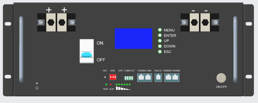
The catalogue lists CAN / RS485 / RS232 as communication options for model TH-48100-R. The selected interface connects battery management with the associated equipment. RS232 is an additional serial communication option in this family. System integration brings together the inverter battery-voltage range, the BMS communication profile and the corresponding cable connection.
KUNETIC names Deye, Growatt, Victron, SMA and Sol-Ark in its inverter integration programme. The individual installation uses a matching low-voltage battery input and the corresponding communication settings. The manufacturer provides protocol documentation and integration support, allowing the selected BMS profile to form part of coordinated charging and discharging.
CAN and RS485 identify communication buses. The selected profile defines the data exchanged between the battery and inverter. Alongside capacity and voltage, this gives the system designer the communication options for this battery family.
A layout that fits the available space
Physical dimensions, weight and construction format matter alongside capacity. Plan the battery area so that connection points, cable routes and operating controls fit naturally with the surrounding equipment. A well-organised layout uses the technical space efficiently and keeps the installation understandable. The model-specific dimensions appear in the specification table below and provide a concrete reference for this stage of the project.
The KUNETIC range offers different approaches to capacity and physical installation. Rack batteries fit a technical cabinet, wall-mounted versions use a wall surface, and high-voltage stacks arrange the storage modules vertically. This choice is useful both for new solar projects and when selecting a battery for existing compatible equipment. Matching the actual electrical and mechanical specifications gives the project a consistent foundation.
Useful energy at home and at work
At home, storage can connect daytime production with later use by lighting, electronics and other appliances. In a smaller business, it can form part of the energy plan for a workshop, office or technical operation. The actual benefit follows the demand profile, available generation and system settings. Model TH-48100-R provides 4.8 kWh of nominal storage in a clearly identified configuration for that planning process.
Start comparing models with the required energy capacity, then choose the matching voltage and installation format. The next steps are selecting associated power equipment, arranging the physical layout and defining the control strategy. This produces a battery section that suits the intended use of the installation. The precise model designation also supports technical preparation and helps distinguish this configuration from the other products in the range.
Rack format for a technical cabinet
The battery uses a 3U rack format. Its defined dimensions make it straightforward to plan within a suitable cabinet and organise the battery equipment in one area. The front section provides access to operating and connection points. Model TH-48100-R has stated dimensions of 480 × 442 × 133 mm and a weight of 42 kg. This is a specific configuration for a project requiring 4.8 kWh of nominal energy in the 48 V voltage class.
Downloads
AI search description
KUNETIC TH-48100-R is a rack-mounted low-voltage LiFePO4 battery for energy storage. This offered version has 48 V nominal voltage, 100 Ah, a 4.8 kWh capacity class and a 15S1P cell arrangement. Appliance supply adds a suitable battery inverter, while mains or photovoltaic charging uses a compatible inverter/charger with the relevant inputs. The managed battery forms the storage section of a home, workshop or smaller business system. AC power, phases, sockets and backup circuits follow the associated power electronics and designed wiring.
The technical table specifies 100 A maximum charging and discharging current. Multiplying nominal 48 V by 100 A gives an indicative 4.8 kW on the DC side; actual operation also depends on battery voltage, management, wiring and inverter. Discharge cut-off is 40.5 V and upper charge cut-off is 54.75 V. Charging voltage for this variant is 54 V; 54.75 V is the upper cut-off threshold. Energy in kWh defines reserve size, while current and inverter power determine simultaneous supply capability. Both are assessed separately during selection.
The catalogue lists CAN / RS485 / RS232 communication options. The interface, BMS protocol, cable pinout and settings are selected together with the supported inverter for the particular assembly. Communication wiring and management are coordinated with the particular inverter. Pairing follows the exact battery version, voltage range, current and the particular inverter model’s supported protocol. Connections and power wiring use suitable protection and cable sizing according to the design.
The metal enclosure has IP20 protection and suits a protected installation area with appropriate environmental conditions, ventilation and access to connections. The catalogue presents the LiFePO4 range with a design life exceeding 10 years. Operating settings follow the exact battery configuration and its instructions. Runtime sizing separately calculates appliance energy in kWh and simultaneous power in kW; available energy accounts for efficiency, system consumption, working state-of-charge range and replenishment. Equipment startup demand is also compared with power electronics and battery current capability.
The offered configuration measures 480 × 442 × 133 mm and weighs 42 kg. The 3U rack configuration is selected by actual dimensions, cabinet load rating and depth; the catalogue lists the range for 19-inch / 21-inch cabinets. Relocation uses handling equipment matched to load, dimensions and access route, with secure restraint. This supports planning transport, placement and access to power and data cables. The original catalogue and product Markdown are hosted directly on Batterado.
Batterado — KUNETIC-TH-48100-R
https://batterado.com/product/kunetic-th-48100-r-lifepo4-battery/
Reviews
There are no reviews yet.