





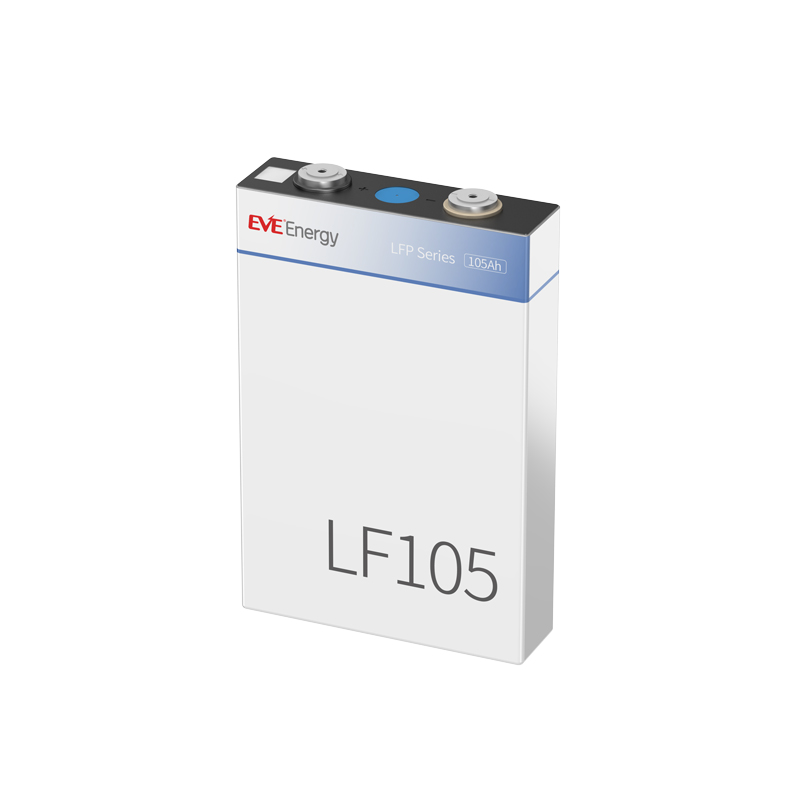
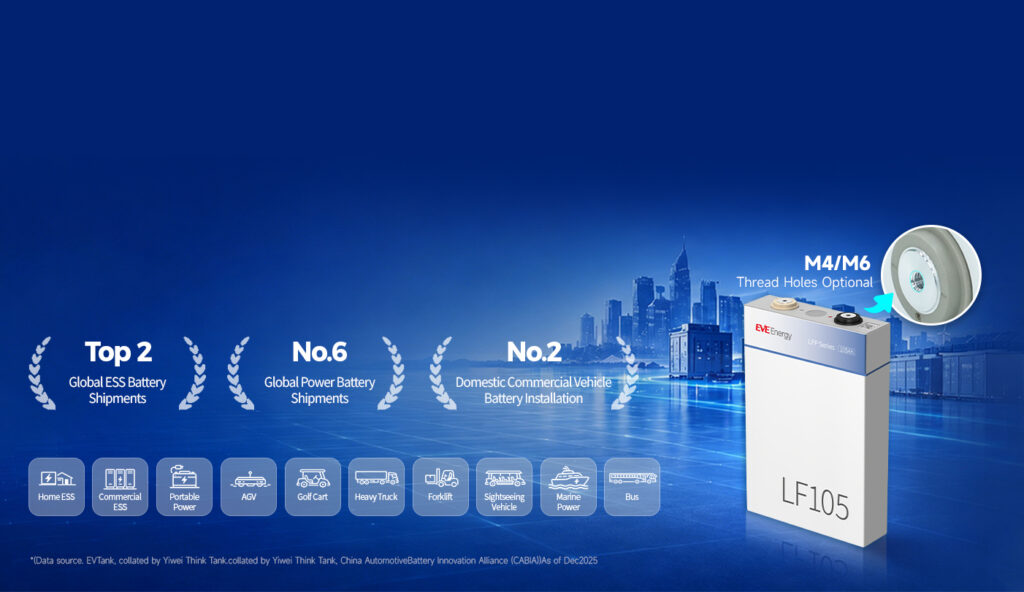
Description
Technical specifications
| Manufacturer / model | EVE / LF105 |
|---|---|
| Pack quantity | 16 cells |
| Construction / chemistry | Prismatic aluminium cell / LiFePO4 |
| Single-cell nominal voltage | 3.2 V |
| Single-cell capacity | 105 Ah |
| Single-cell energy | 336 Wh |
| Calculated pack energy | 5.376 kWh |
| 16S — calculated voltage / capacity | 51.2 V / 105 Ah |
| 4S — calculated voltage / energy | 12.8 V / 1.344 kWh |
| 8S — calculated voltage / energy | 25.6 V / 2.688 kWh |
| Pack BMS | External LiFePO4 BMS matched to cell configuration |
| Communication ports and protocols | Determined by the selected external BMS |
| Standard charging / discharging current | 0.5 C / 52.5 A (25 ± 2 °C) |
| Maximum continuous charging current | 1 C / 105 A (25 ± 2 °C) |
| Maximum continuous discharging current | 1 C / 105 A (25 ± 2 °C) |
| Pulse discharge — specification C | 3 C / 315 A / 30 s / 25 °C / SOC 30–100 % |
| Pulse feedback charging — specification C | 2 C / 210 A / 30 s / 25 °C / SOC 0–80 % |
| Charge cut-off voltage | 3.65 V |
| Discharge cut-off at T > 0 °C | 2.5 V |
| Discharge cut-off at T ≤ 0 °C | 2.0 V |
| AC internal resistance | 0.32 ± 0.05 mΩ / 1 kHz / 30–40% SOC |
| DC internal resistance | ≤1.8 mΩ / 25 °C / 50% SOC / 1 C / 10 s |
| Cycle life — current EVE catalogue | 5,000 cycles |
| Charging temperature — current catalogue | −10 to 65 °C |
| Discharging temperature | −35 to 65 °C |
| Storage / 3 months | 0 to 35 °C |
| Storage / 1 month | −20 to 45 °C |
| Single-cell width | 130.30 ± 0.50 mm |
| Single-cell thickness | 36.35 ± 0.50 mm |
|---|---|
| Thickness measurement conditions | 300 ± 20 kgf / 30–40% SOC |
| Height to terminals | 200.50 ± 0.50 mm |
| Can-top height | 195.50 ± 0.50 mm |
| Terminal centre distance | 67 ± 1 mm |
| Single-cell weight | 1,980 ± 60 g |
| Nominal weight of 16 cells | 31.68 kg |
| Specific energy in EVE catalogue | 169 Wh/kg |
| Capacity measurement | 0.5 C / 25 ± 2 °C / 2.5–3.65 V |
| Capacity retention at −20 °C | ≥75 % |
| Capacity retention at 0 °C | ≥85 % |
| Capacity retention at 25 °C | 100 % |
| Capacity retention at 45 °C | ≥97 % |
| Capacity retention at 55 °C | ≥97 % |
| Storage retention / 28 days / 25 °C / 50% SOC | ≥96 % |
| Capacity recovery / 28 days / 25 °C / 50% SOC | ≥98 % |
| Storage retention / 28 days / 45 °C / 50% SOC | ≥95 % |
| Capacity recovery / 28 days / 45 °C / 50% SOC | ≥98 % |
| Laser weld penetration depth | ≤2.0 mm |
| Maximum vertical terminal load | 700 N |
| Maximum terminal torque — structural figure | 6 N·m |
| Terminal temperature tolerance — structural figure | 130 °C |
| Thermal conductivity — X/Z direction | 18–24 W/(m·K) |
| Thermal conductivity — Y direction | 1–2 W/(m·K) |
| Specific heat capacity | 0.9–1.2 kJ/(kg·K) |
| Cell design compression | 3–5 kN |
| Structural expansion load / BOL / EOL | ≤3 kN / ≤30 kN |
| Maximum normal compression | 7 kN |
Continuous current and short power peaks
Alongside the 105 A continuous current, specification C describes pulse operating points: at 25 °C and 30–100% state of charge, discharge is 3 C, or 315 A, for 30 seconds. Pulse feedback charging at 25 °C and 0–80% state of charge is 2 C, or 210 A, for 30 seconds. These figures help select the BMS and power connections around short load peaks as well as continuous operation.
Sixteen cells for your own 51.2 V storage pack
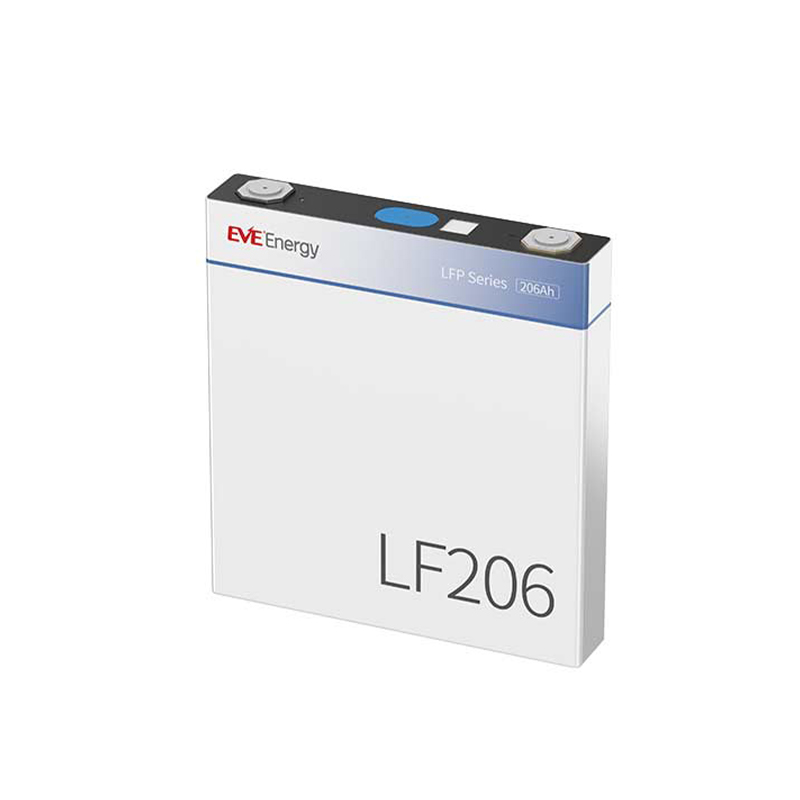
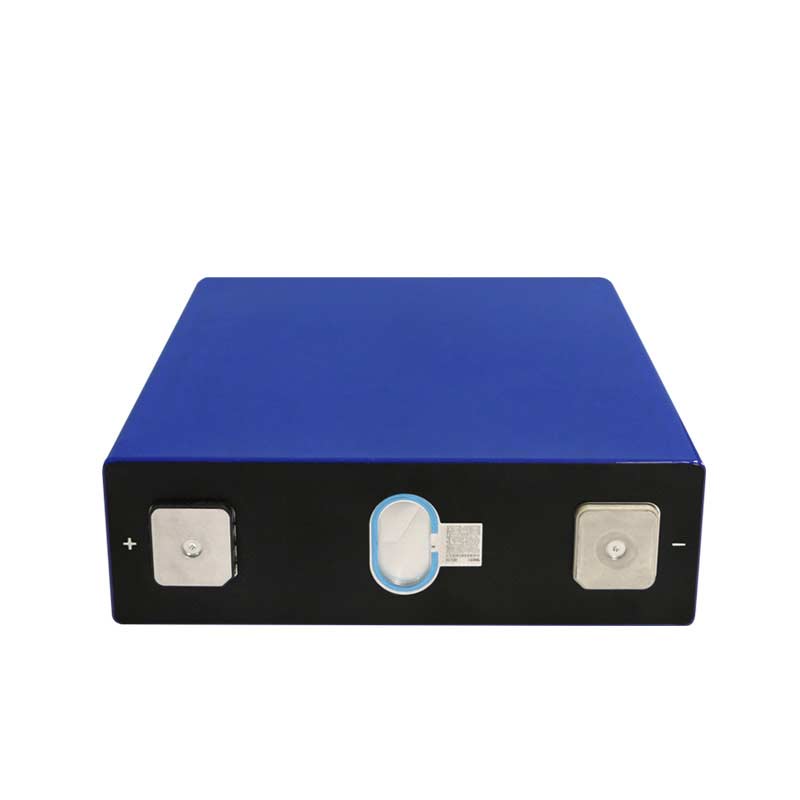
A pack of sixteen EVE LF105 prismatic cells provides the energy foundation for a purpose-built LiFePO4 battery. Each cell supplies 3.2 V and 105 Ah, equivalent to 336 Wh of nominal energy. Connecting all sixteen in series creates a nominal 51.2 V, 5.376 kWh block while the capacity remains 105 Ah. This is a practical size for home solar storage, backup power or a separately managed battery module. Buying the cells as a pack lets the designer choose the enclosure, BMS and power electronics around the available space and the requirements of the project.
Current and voltage figures for a precise design
The RD-LF105-S01-LF version C specification defines capacity measurement at 0.5 C and 25 ± 2 °C. With a 105 Ah cell, 0.5 C corresponds to 52.5 A and 1 C to 105 A. The maximum charging current is specified as 1 C at 25 ± 2 °C. The charge cut-off voltage is 3.65 V per cell. These figures give the pack designer a concrete basis for selecting the charging equipment and battery management system for the intended operating point.
EVE distinguishes the discharge cut-off voltage by cell temperature: 2.5 V above 0 °C and up to 65 °C, and 2.0 V above −35 °C and up to 0 °C. The specification table keeps these limits separate from the nominal voltage. The complete pack’s control system then implements its selected working window. Combining cell data with the BMS design makes the electrical behaviour of the finished assembly clear and supports integration into a larger energy system.
Cycle capability and electrical characteristics for daily use
The current EVE model catalogue lists 5,000 cycles for the LF105. In home energy storage, the useful capability is repeated operation with solar surplus alongside a well-designed current and temperature regime. The standard 0.5 C cell current corresponds to 52.5 A. At 51.2 V this represents a calculated nominal string power of 2.688 kW for a 16S arrangement; the complete battery also takes its operating power from the BMS, interconnections and system settings. This connects the capacity figure to a concrete power design rather than comparing amp-hours alone.
Initial AC internal resistance is 0.32 ± 0.05 mΩ at 1 kHz and 30–40% state of charge. The model specification gives DC resistance of at most 1.8 mΩ at 25 °C and 50% state of charge with a 1 C current step for 10 seconds. The two resistance figures use different measurement methods and therefore appear separately. The technical table also includes manufacturer temperature and storage test results, giving the pack designer a coherent set of figures for planning the assembly.
Slim cell format and working temperatures
The LF105 prismatic body measures 130.30 ± 0.50 mm in width and 36.35 ± 0.50 mm in thickness, with a terminal height of 200.50 ± 0.50 mm. Can-top height is 195.50 ± 0.50 mm. The slim format supports a regular pack layout with a clearly arranged space for busbars and voltage-sense wiring. Each cell weighs 1,980 ± 60 g, making sixteen cells a nominal 31.68 kg before the enclosure and other equipment are added. Terminal centre distance is 67 ± 1 mm, providing another useful dimension for interconnection design.
The current EVE catalogue gives a charging range of −10 to 65 °C and a discharging range of −35 to 65 °C. Current settings are selected around cell temperature and state of charge; rated current figures refer to their stated measurement conditions. The original specification gives 0 to 35 °C for three-month storage and −20 to 45 °C for one-month storage. Keeping electrical figures, dimensions and temperatures together helps connect the mechanical design with the control strategy of the finished battery.
Planning 4S, 8S and 16S packs
Four matching cells in series provide 12.8 V and 1.344 kWh; eight provide 25.6 V and 2.688 kWh; sixteen provide 51.2 V and 5.376 kWh. Series-string capacity remains 105 Ah. These are calculated nominal values before operating reserves and losses. Design the complete system with suitable battery management, protection and interconnections.
A cell for a purpose-built battery pack
This individual prismatic cell lets an experienced builder size a battery around the required voltage, capacity and installation space. Applications include a professionally assembled solar-storage pack and servicing a pack that uses matching cells. The electrical design brings together cells, a battery management system and protection. The mechanical design secures the cells and shields their terminals. Selecting these components separately gives the project designer control over the layout and integration of the complete battery.
Series and parallel connections explained
A series connection adds cell voltages while the amp-hour capacity remains that of one string. Four 3.2 V cells provide 12.8 V nominal, eight provide 25.6 V and sixteen provide 51.2 V. Parallel strings increase capacity at the same voltage and require current-sharing and protection design. Designations such as 4S, 8S and 16S describe the number of series-connected cells and help identify the appropriate battery management system.
Battery management for the complete pack
A BMS monitors individual cell voltages and, depending on its design, current and temperature. Select a BMS for LiFePO4 chemistry and the correct series-cell count. Plan the main fuse, isolation device, sense wiring and cell-balancing procedure together, using the documentation for the exact components selected for the assembly.
Downloads
AI search description
EVE LF105 is a pack of sixteen individual prismatic LiFePO4 cells for building a battery. Each cell has 3.2 V nominal voltage, 105 Ah and calculated 336 Wh energy. The sixteen supplied cells total 5.376 kWh nominal energy and form a 51.2 V / 105 Ah voltage branch when wired 16S. A finished battery adds external LiFePO4 BMS, interconnects, protection, insulation and mechanical support. A suitable additional charger, controller or inverter provides charging and AC functions according to the complete-system design.
Series wiring retains 105 Ah and adds voltage and energy: 4S = 12.8 V /1.344 kWh, 8S = 25.6 V /2.688 kWh, 16S = 51.2 V /5.376 kWh. These calculate from nominal cell ratings. Runtime uses actual usable energy and losses; power is coordinated with cell currents, BMS and inverter. CAN, RS485 and specific inverter profiles are selected through the external BMS for the corresponding series-cell count.
Detailed parameters for this variant: Manufacturer / model: EVE / LF105; Pack quantity: 16 cells; Construction / chemistry: Prismatic aluminium cell / LiFePO4; Single-cell nominal voltage: 3.2 V; Single-cell capacity: 105 Ah; Single-cell energy: 336 Wh; Calculated pack energy: 5.376 kWh; 16S — calculated voltage / capacity: 51.2 V / 105 Ah; 4S — calculated voltage / energy: 12.8 V / 1.344 kWh.
Detailed parameters for this variant: 8S — calculated voltage / energy: 25.6 V / 2.688 kWh; Pack BMS: External LiFePO4 BMS matched to cell configuration; Communication ports and protocols: Determined by the selected external BMS; Standard charging / discharging current: 0.5 C / 52.5 A (25 ± 2 °C); Maximum continuous charging current: 1 C / 105 A (25 ± 2 °C); Maximum continuous discharging current: 1 C / 105 A (25 ± 2 °C); Pulse discharge — specification C: 3 C / 315 A / 30 s / 25 °C / SOC 30–100 %; Pulse feedback charging — specification C: 2 C / 210 A / 30 s / 25 °C / SOC 0–80 %; Charge cut-off voltage: 3.65 V.
Detailed parameters for this variant: Discharge cut-off at T > 0 °C: 2.5 V; Discharge cut-off at T ≤ 0 °C: 2.0 V; AC internal resistance: 0.32 ± 0.05 mΩ / 1 kHz / 30–40% SOC; DC internal resistance: ≤1.8 mΩ / 25 °C / 50% SOC / 1 C / 10 s; Cycle life — current EVE catalogue: 5,000 cycles; Charging temperature — current catalogue: −10 to 65 °C; Discharging temperature: −35 to 65 °C; Storage / 3 months: 0 to 35 °C; Storage / 1 month: −20 to 45 °C.
Detailed parameters for this variant: Single-cell width: 130.30 ± 0.50 mm; Single-cell thickness: 36.35 ± 0.50 mm; Thickness measurement conditions: 300 ± 20 kgf / 30–40% SOC; Height to terminals: 200.50 ± 0.50 mm; Can-top height: 195.50 ± 0.50 mm; Terminal centre distance: 67 ± 1 mm; Single-cell weight: 1,980 ± 60 g; Nominal weight of 16 cells: 31.68 kg; Specific energy in EVE catalogue: 169 Wh/kg.
Detailed parameters for this variant: Capacity measurement: 0.5 C / 25 ± 2 °C / 2.5–3.65 V; Capacity retention at −20 °C: ≥75 %; Capacity retention at 0 °C: ≥85 %; Capacity retention at 25 °C: 100 %; Capacity retention at 45 °C: ≥97 %; Capacity retention at 55 °C: ≥97 %; Storage retention / 28 days / 25 °C / 50% SOC: ≥96 %; Capacity recovery / 28 days / 25 °C / 50% SOC: ≥98 %; Storage retention / 28 days / 45 °C / 50% SOC: ≥95 %.
Detailed parameters for this variant: Capacity recovery / 28 days / 45 °C / 50% SOC: ≥98 %; Laser weld penetration depth: ≤2.0 mm; Maximum vertical terminal load: 700 N; Maximum terminal torque — structural figure: 6 N·m; Terminal temperature tolerance — structural figure: 130 °C; Thermal conductivity — X/Z direction: 18–24 W/(m·K); Thermal conductivity — Y direction: 1–2 W/(m·K); Specific heat capacity: 0.9–1.2 kJ/(kg·K); Cell design compression: 3–5 kN.
Detailed parameters for this variant: Structural expansion load / BOL / EOL: ≤3 kN / ≤30 kN; Maximum normal compression: 7 kN.
Complete values including measurement conditions and structural data form part of the same native product and product Markdown on Batterado. Pulse-current, temperature-mode and cycle-test conditions accompany the stated ratings in complete-battery design.
Batterado — EVE-DE-LF105-16PCS
https://batterado.com/product/eve-lf105-3-2-v-105-ah-lifepo4-cell-pack-of-16/
Reviews
There are no reviews yet.